
How AI Can Help Beauty Salons Get More Repeat Customers
Most salons do not have a lead problem. They have a return problem. People visit once, enjoy the service, and then disappear into a busy life full of other options. AI does not create loyalty by magic, but it helps salons notice patterns, follow up at the right moment, recommend relevant services and make every return visit feel more personal.
Can AI really help salons get more repeat customers?
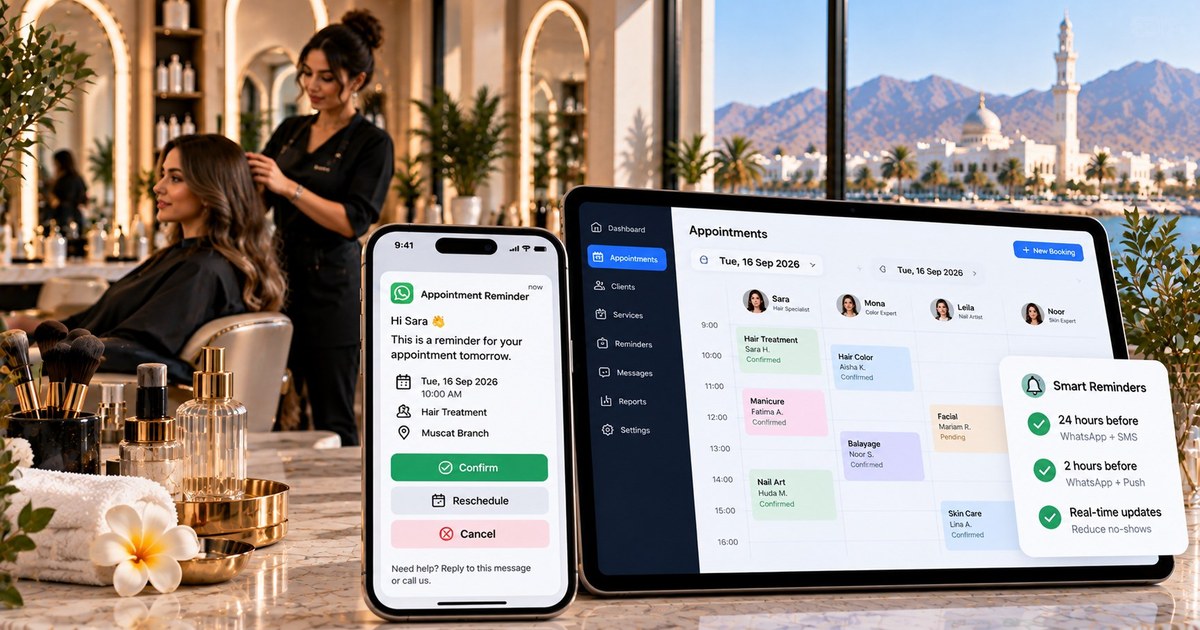
Yes, if it is connected to a real salon workflow. AI helps beauty salons get more repeat customers by identifying when each client is most likely to return, sending personalized reminders, recommending the right next service, helping the team follow up consistently and learning from behavior over time. The important part is not the buzzword. The important part is having structured data — booking history, service preferences, timing, communication responses and loyalty behavior — so the system can support smart actions instead of generic mass messages.
For salons in Oman, this matters because many businesses already manage conversations in WhatsApp, bookings in a separate tool and client notes in the stylist’s memory. That setup can work at a small scale, but it becomes weak when the salon wants predictable growth. A proper system combines AI booking, a strong client profile, a thoughtful loyalty program, smart appointment reminders and human service. AI is the layer that helps all of those parts work together, so more first-time visitors become regular clients.
Why repeat customers matter more than most salon owners think
Most salon owners naturally focus on getting new clients. New clients are visible. They come from Instagram, referrals, walk-ins, a Google search, a promotion or a collaboration. They feel like growth. But a salon that only chases new traffic usually becomes more stressful to operate, not more profitable. The team keeps spending time explaining services to first-time visitors, handling uncertainty, and filling the calendar from scratch every week. When a salon has more repeat customers, scheduling becomes easier, forecasting becomes more reliable and revenue quality improves.
A repeat client is more than a second transaction. She already knows your location, your atmosphere, your booking method and your team. The trust barrier is lower. She is more likely to try a package, accept an upgrade, book a longer service or refer a friend. She is also easier to serve well because the salon can remember what happened on the last visit. That makes the experience smoother for both the client and the staff.
In practice, repeat business changes the rhythm of a salon. Instead of asking, “How do we attract enough people for next week?” the better question becomes, “How do we make sure our good clients keep coming back at the right interval?” A hair-color client might need a different rhythm from a blow-dry client. A nail client may return every two to three weeks. A keratin or treatment client may come back after a longer gap. A generic campaign treats all of them the same. A smart retention system does not.
This is exactly where AI becomes useful. It does not replace hospitality or service quality. It helps the business see each client more clearly and act earlier. If the system notices that a regular client usually returns every 30 days and she is now at day 42 with no booking, that is a practical signal. If another client responds only to WhatsApp but ignores email, that is also a practical signal. Good retention comes from hundreds of small, consistent decisions. AI helps scale those decisions.
Why clients do not come back — and why most salons guess instead of knowing
When a client does not return, salon teams often explain it emotionally: she forgot, she got busy, she moved, she found somewhere cheaper, or she just was not serious. Sometimes those explanations are true. But many non-returns happen because the salon did not create a clear path to the next visit. There was no timely follow-up. There was no personalized recommendation. No one remembered the client’s preference. The salon did not make rebooking easy. The next-step decision was left entirely to the client, and life took over.
Here are common reasons a client does not return:
- The experience was acceptable but not memorable enough to create a strong habit.
- The salon did not follow up after the visit or followed up too late.
- The client was interested in another service but received no relevant suggestion.
- The booking process felt difficult, unclear or slow.
- The salon forgot previous preferences, making the client feel anonymous.
- The client changed her schedule and there was no easy way to rebook.
- Offers and reminders felt generic or irrelevant.
- There was no visible benefit to staying loyal, such as rewards, recognition or convenience.
Without data, the salon can only guess which reason applies to which person. With structured data, the salon can segment and respond. A client who used to come every 21 days but stopped after her last service needs a different message from a brand-new client who visited once six months ago. A client who buys treatment services may respond to a maintenance reminder. A bridal or event client may need a seasonal campaign. A premium client may respond better to early access or priority slots than to a discount.
AI becomes powerful not because it sends messages automatically, but because it helps separate these cases. It can score likelihood of return, group clients by service pattern, detect inactivity, suggest the right moment to reconnect and recommend the most relevant next action for the team. That is a much smarter approach than broadcasting the same “Hello dear client, we miss you” message to everyone in the database.
What AI really means inside a salon retention system
For salon owners, “AI” should be translated into practical business functions. It should not mean a mysterious black box or a dramatic robot personality. In a salon context, AI usually means software that can analyze client behavior, predict useful next steps and trigger or support actions that would be too hard to manage manually at scale.
For example, AI can estimate an expected revisit window for each client by learning from service history. If a client normally books a gel refill every 20 to 24 days, the system can recommend sending a message at the right moment rather than using a fixed monthly broadcast. If another client tends to book a haircut every seven weeks but sometimes delays when she is busy, the system can suggest a softer follow-up instead of an aggressive offer.
AI can also improve recommendations. Imagine a client who regularly books hair color and occasionally adds a treatment. The system can infer that a treatment reminder after a coloring cycle is relevant. Or consider a skin-care client who booked a facial and then purchased a package but has two sessions left unused. AI can surface that fact before the client disappears from the calendar.
Another practical role is prioritization. Salon teams often have too many clients to follow up with all at once. AI can rank clients by opportunity: high-value regulars who are overdue, one-time visitors with strong second-visit potential, clients at risk of churn after a no-show, or VIP members who need a personal touch. This helps staff spend their time where it matters most.
Finally, AI helps with timing and channel selection. Some people respond quickly on WhatsApp. Some are more likely to click a booking link than start a long chat. Some prefer Arabic content, others English. Some react positively to a reminder with a favorite stylist’s name, while others care more about available evening slots. The more the system learns, the less random marketing becomes.
A repeat-customer strategy only works if the client profile is strong
AI needs context. That context lives inside the client profile. If the profile is incomplete, the system will act generically. If the profile is rich, AI can act like a careful assistant.
A useful salon client profile should include the basics — name, phone number, preferred language, visit dates and service history — but it should also capture details that improve service and retention. That can include favorite stylist, skin or hair notes, preferred time of day, communication preference, loyalty status, referral activity, cancellation pattern, birthdays or special occasions, and any important service notes that the team should remember.
This is why we treated the personal client profile as a full article in this series. A profile is not only for record keeping. It is the memory of the relationship. When AI uses that memory well, the client feels understood. When the salon ignores it, the client feels like a stranger every time she returns.
Good retention often comes from simple acts of relevance. Remembering that a client prefers a quieter appointment time. Noticing that she usually books before travel season. Suggesting a service that logically follows her previous one. Recommending her preferred stylist when a prime slot becomes available. Each of these actions becomes easier when the system has a complete profile and the AI layer can reason over it.
How AI can actually help salons get more repeat customers
Let’s move from theory to specific workflows. The following use cases are where AI provides real value for salons in Oman.
1) Predicting the right time to invite a client back
The simplest retention mistake is poor timing. Contact a client too early and the message feels irrelevant. Contact her too late and she may already have booked elsewhere. AI can estimate revisit timing based on service type, personal history and booking behavior. That means a salon can invite a client back when the message feels useful, not random.
This is especially valuable for services with natural maintenance cycles. Hair color, root touch-ups, brow work, nail care, facials and treatments all tend to create different revisit windows. A rule-based system can handle part of this, but AI becomes more accurate when it learns from each individual’s actual pattern.
2) Personalizing the follow-up message
Personalization is not about dropping someone’s name into a message. It is about sending the right message with the right reason. AI can choose the right context: “It has been six weeks since your last color appointment,” “You still have one session left in your package,” “Your favorite stylist has evening availability next week,” or “Your birthday month benefit is active.” Messages like these feel more relevant because they are grounded in behavior.
3) Recommending the next best service
Repeat customers do not always come back for the exact same service. Sometimes retention grows because the salon recommends a complementary next step. A haircut client may respond to a treatment suggestion. A facial client may be ready for a follow-up package. A manicure client may book a pedicure before an event. AI can look for patterns across service combinations and suggest the next best offer with better timing than a generic promotional blast.
4) Recovering clients who are drifting away
Some clients churn quietly. They do not complain. They simply stop booking. AI can identify this early by comparing a client’s normal revisit pattern with current inactivity. Instead of waiting six months and declaring her “lost,” the salon can start a recovery flow after a meaningful delay. The first message may be a gentle check-in. The second may highlight a useful slot or stylist availability. The third may include a loyalty reminder or package benefit. The goal is not to pressure the client. The goal is to reopen the relationship before it goes cold.
5) Helping the team prioritize who deserves a personal call
Not every client should receive the same level of manual effort. AI can score clients based on visit frequency, total spending, service mix, responsiveness and time since last visit. This helps managers or reception teams decide who should get a personalized call, who should receive an automated reminder and who belongs in a broader campaign. A client who used to visit monthly and suddenly stopped may deserve a more personal touch than a one-time coupon hunter.
6) Making loyalty programs smarter
A loyalty program works best when it supports actual behavior, not just transactions. When the salon combines AI with a proper loyalty program, it can identify what incentive matters most. One client may respond to points. Another may care more about priority slots, birthday benefits, referral rewards or a “welcome back” perk. AI helps the system match the reward to the person rather than treating all clients equally.
7) Preventing friction before it hurts retention
Retention is not just about promotions. It is also about reducing small annoyances. AI can surface if a client experienced repeated rescheduling, multiple no-shows, long gaps in confirmation, or frequent communication delays. That gives the salon a chance to improve service before the relationship weakens. Sometimes the smartest retention action is not a marketing message. It is fixing a process problem.
8) Supporting after-care and trust-building
For treatments, color work or other services that benefit from after-care, AI can trigger helpful follow-up content: simple care advice, a recommended timeframe for the next visit, or a reminder that a package session remains unused. Useful after-care builds trust. Trust improves repeat behavior. This works especially well when the message feels educational rather than salesy.
9) Coordinating with reminders and rebooking
Retention does not live in one feature. It works best when AI collaborates with booking and reminders. A client who ignores a return suggestion but opens appointment reminders may still be highly engaged. A client who reschedules often may need different timing. A client who booked once, then no-showed, may need a different recovery flow than a loyal regular. This is why smart reminders and retention strategy belong together.
How AI works with WhatsApp, booking, reminders and loyalty
In many salons, WhatsApp is the most visible communication layer, but it should not be the only layer. As we explained in Why WhatsApp Alone Is Not Enough for Salon Booking, a chat app is not the best place to store business memory. The real advantage comes when WhatsApp is connected to a structured system.
Here is what a good integrated flow looks like. A client books through the salon system or through a team-assisted booking flow. The appointment goes into the real calendar. The service and stylist are attached to the client profile. Smart reminders reduce no-shows. After the visit, the system updates service history, loyalty activity and follow-up timing. AI then monitors the profile and decides when a revisit suggestion, educational follow-up or benefit reminder makes sense. WhatsApp can still deliver the message — but the intelligence lives in the system.
This integration matters because repeat customers are built over multiple moments. Booking, attendance, service quality, after-care, rewards and follow-up all affect whether the client comes back. AI only becomes useful when it can read across those moments and act consistently.
What makes this especially relevant for salons in Oman
Salon businesses in Oman operate in a mix of modern customer expectations and relationship-based service culture. Many clients appreciate convenience, fast communication and respectful personalization. They also expect clarity. They want to know the right service, the right specialist, the available time and the easiest way to return. That makes AI-assisted retention a strong fit — if it is implemented with taste.
Language matters too. Some clients prefer English, others Arabic, and many salons serve mixed audiences. An AI-enabled system can segment by language and communication preference so follow-up feels natural. Timing matters as well. A professional client in Muscat may respond to evening availability, while another client may prefer daytime slots during weekdays. A salon with multiple branches can also use AI to suggest the nearest or most relevant location based on habit.
Most importantly, Oman-based salons should use AI to improve service quality, not to become overly promotional. Clients usually respond well when the salon seems organized, considerate and genuinely helpful. They respond poorly when the system becomes noisy. Relevance is the difference.
Personalization must respect privacy and consent
Because AI relies on client data, salons need clear rules. Clients should understand that the salon stores their booking history and service information for operational and service-quality purposes. If the salon uses that data for marketing follow-up, the communication should respect local data-protection rules and client expectations. In practical terms, that means collecting only useful information, storing it securely, limiting staff access, and offering an easy way for clients to opt out of promotional messaging.
Trust is a retention asset. If a client feels that the salon is careful with her information, she is more likely to continue the relationship. If she feels watched or spammed, the opposite happens. Good AI systems should make communication more respectful, not more intrusive.
A practical implementation roadmap for salon owners
If you want more repeat customers, do not start with the most advanced AI feature. Start with the foundation and build in the right order.
- Clean the booking flow. Make sure appointments, staff calendars and service durations are recorded properly.
- Build a useful client profile. Service history, preferences, language and contact channels should be consistent.
- Add reliable reminders. A salon cannot build retention on top of missed appointments and messy communication.
- Define revisit logic. Identify your common service cycles and a first version of return timing.
- Connect loyalty and offers. Give clients a reason to feel recognized, not just advertised to.
- Introduce AI gradually. Start with revisit timing, follow-up recommendations and prioritization before moving to more advanced automation.
- Measure results. Track repeat rate, time between visits, rebooking percentage, campaign response, package usage and retention by service category.
This roadmap matters because many salon systems fail by trying to automate chaos. AI performs best when the business already knows its core workflow. Once the basics are stable, AI can increase consistency and scale personal attention without making the salon feel robotic.
That is also why these guides are connected. A strong retention system depends on smart booking, a complete client profile, a clear reminder strategy, and a meaningful loyalty structure. AI turns these separate pieces into a coordinated system that helps the salon act at the right moment.
Want more clients to return without sending random promotions?
We design practical salon systems that combine online booking, client profiles, reminders, loyalty logic and AI-assisted follow-up so your team can increase repeat visits with less manual effort.
FAQ about AI and repeat salon customers
Can AI really increase repeat salon visits?
AI does not guarantee loyalty on its own, but it can materially improve repeat behavior when it is connected to booking data, client profiles, reminders and offers. Its main value is identifying the right moment, message and next action for each client instead of relying on generic campaigns.
Do salons need a large database before using AI?
No. A salon does not need a huge database to begin. Even a modest client list becomes more valuable when service history, revisit timing and communication preferences are organized. AI becomes more accurate as data quality improves, but it can still help with follow-up structure at an earlier stage.
What data should a salon collect to improve repeat visits?
The most useful data includes visit history, services booked, time between visits, preferred stylist, preferred language, communication preference, loyalty activity, package usage and relevant service notes. The goal is not to collect everything; it is to collect what helps the salon serve the client better.
Is WhatsApp enough for client retention?
WhatsApp is a valuable communication channel, but it should not be the only place where customer memory lives. For effective retention, WhatsApp should be connected to a proper booking and CRM system so reminders, follow-up logic and client history are structured.
What is the best first AI use case for a salon?
The best first use case is usually revisit timing and personalized follow-up. It is practical, measurable and immediately connected to revenue. After that, salons can expand into recommendations, recovery campaigns, segmentation and staff prioritization.
How does AI help premium or VIP clients?
AI helps VIP retention by surfacing high-value clients who are overdue, highlighting service preferences, prioritizing personal follow-up and supporting more relevant benefits such as priority slots, package reminders or tailored offers instead of blanket discounts.
Can AI replace salon staff in customer relationships?
No, and it should not try to. The best role for AI is to support the staff with memory, timing, prioritization and recommendations. The human relationship remains central. AI simply helps the team deliver that relationship more consistently.
Will AI make communication feel robotic?
It can if it is implemented badly. But a well-designed system does the opposite: it reduces irrelevant mass messaging and helps the salon send fewer, more useful messages that feel more timely and personal.
How should salons in Oman handle privacy when using AI?
They should collect only useful data, store it securely, control staff access, be transparent about how information is used and respect consent for promotional messaging. Personalization works best when it is built on trust.
Soroush Moghaddami
Founder of Filtori and an applied AI systems architect focused on business automation, databases and practical software systems. His work includes custom booking, customer-management and AI-assisted operational platforms.
View the English author profile →AI should make your salon feel more personal, not more automated.
If you want to increase repeat visits in Oman, the right solution is not another generic promotion. It is a joined-up system: booking, client profile, reminders, loyalty and smart follow-up working together.