
Why WhatsApp Alone Is Not Enough for Salon Booking
WhatsApp is one of the best ways for a salon to stay close to clients. But a conversation thread is not the same thing as a booking system. When availability, staff calendars, service duration, deposits, reminders, client history and reporting all live inside chat, the salon eventually starts managing appointments by memory.
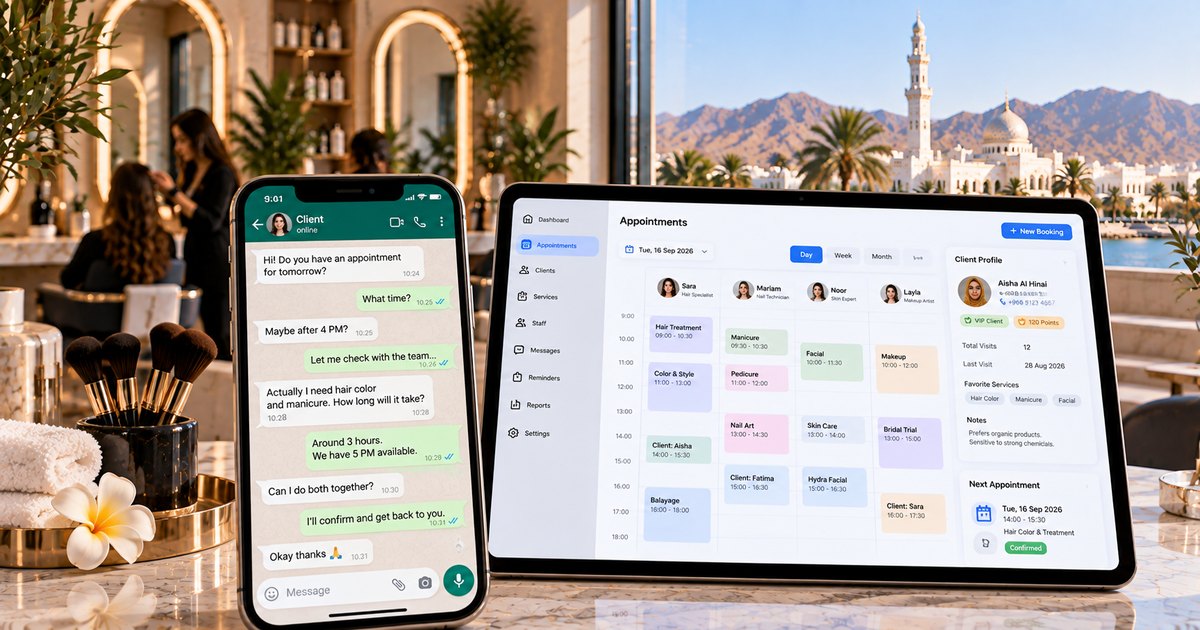
WhatsApp is a communication channel, not a reliable appointment database.
For a salon in Oman, the strongest setup is usually not “WhatsApp or online booking.” It is WhatsApp plus a structured booking system. Clients can still ask questions, send references and receive helpful updates through WhatsApp. The actual appointment, however, should live in a system that knows the branch, service, duration, specialist, available time, deposit status, client profile and booking status.
That separation sounds technical, but the benefit is simple: fewer double bookings, less back-and-forth, clearer records and a smoother experience for both staff and clients.
WhatsApp is popular for salon booking because it genuinely works well for conversation
There is a reason salons rely on WhatsApp. It feels personal. A client can send a photo of the hairstyle she wants, ask whether a treatment is suitable, check if her preferred stylist is working, or say that she is running ten minutes late. The receptionist can answer naturally. There is no unfamiliar interface, no new account to learn and no formal support ticket.
For small teams, that flexibility can feel like the perfect system. One phone number, one inbox, one place where customers already know how to talk. If a salon has only a handful of appointments per day, manual coordination can stay manageable for a long time.
The mistake is not using WhatsApp. The mistake is asking WhatsApp to do jobs it was never designed to do: become the calendar, the client database, the availability engine, the package ledger, the reminder system and the management dashboard at the same time.
The Oman market already shows the hybrid model in practice
Look at how a modern salon in Muscat handles the problem. Muscat Hair & Beauty Salon publishes WhatsApp contact options for its branches, so clients can still have a direct conversation with the team. At the same time, the salon has a separate online booking flow where a customer chooses a branch, services, a team member and an available time.
That combination is important. It does not force the client to abandon WhatsApp. It simply gives different tools different jobs. WhatsApp handles human communication. The booking flow handles structured appointment data.
For salons across Muscat and the wider Omani market, this model is practical because customer behavior does not have to change dramatically. The booking page can be opened from Instagram, Google, a website or even a WhatsApp message. After the booking is confirmed, WhatsApp can still be used for support, directions, preparation instructions or a reminder.
What goes wrong when the WhatsApp chat becomes the booking system?
Most booking problems are not dramatic. They are small coordination errors repeated every day. A time is promised before another staff member sees the message. A client changes from manicure to manicure plus pedicure, but the calendar still reserves the original duration. A receptionist thinks the client confirmed, while the client thinks she was only asking a question. None of these mistakes require bad staff. They happen because the information is distributed across conversation instead of being stored as one structured appointment.
1. Availability becomes a manual question
“Do you have anything tomorrow evening?” sounds simple. But the answer may depend on the branch, service duration, specialist skill, working hours, breaks, room capacity and bookings that arrived through other channels. In chat, the receptionist has to mentally combine all of that or open another calendar and then come back to the conversation.
A booking engine answers a different question: which slots are actually valid for this exact service and team configuration right now? The customer sees only valid times.
2. Service duration gets lost in the conversation
Salons rarely sell appointments of one standard length. A haircut, hair color, facial, nail extension and bridal package can require very different time blocks. Add-ons change the duration again. If the client asks for an extra service halfway through the chat, the staff member must remember to recalculate the schedule. A structured system can attach duration rules to the service itself.
3. Double booking becomes easier than it looks
Two receptionists may be answering at once. A stylist may accept a request from a regular customer directly. Instagram may generate another lead. A walk-in may be entered on paper. If there is no central calendar that controls the final slot, “available” can mean different things to different people.
4. Important details disappear inside message history
Scroll back far enough and the booking details are there — somewhere. The problem is that operational information should not require archaeology. Staff should be able to open the booking and immediately see the service, branch, time, staff member, status, client note and payment information. That is why a structured client profile matters as much as the calendar.
5. Rescheduling creates multiple versions of the truth
A client first asks for Thursday at 5:00, changes to Saturday at 3:00, then asks whether her preferred stylist is available at 4:00 instead. In chat, the conversation contains every version. The salon still needs one authoritative answer: what is the current appointment? A booking system preserves the current state while keeping a change history if needed.
6. Deposits and cancellation rules are harder to enforce consistently
Some high-value or long-duration services justify a deposit. If the rule is handled manually, staff may apply it differently depending on who is replying. A proper flow can clearly show the requirement, collect payment where supported and mark the booking accordingly. That becomes especially useful when the salon wants to reduce no-shows without creating an argumentative experience.
7. Reporting is almost impossible from raw chat
How many bookings did the salon receive this week? Which services are most requested? What percentage of clients rescheduled? Which specialist is fully booked on Fridays? How many clients returned within eight weeks? Chat history is not designed to answer those questions. A booking database can.
8. The salon becomes dependent on individual memory
The owner remembers that Sara likes late appointments. The receptionist knows which client still has two package sessions. A stylist remembers a previous treatment. This knowledge is useful, but it should not disappear when someone is on leave. A good system turns appropriate operational memory into a shared, permission-controlled record.
Want WhatsApp to stay easy without making staff manage the whole salon inside chat?
Filtori can design the booking flow around your actual services, staff, branches and client journey — while keeping WhatsApp available where conversation is useful.
What a proper salon booking system should do that WhatsApp should not
A booking system does not need to be complicated. Its main job is to protect the operational truth. Every confirmed appointment should exist as a record with clear fields and rules. WhatsApp can then reference that record instead of trying to become it.
Show real availability
Slots should be calculated from staff schedules, service duration, branch rules and existing bookings — not from a receptionist guessing what might still be free.
Create one booking record
Branch, service, specialist, date, time, duration, client and status should live together. Everyone sees the same current appointment.
Connect the client profile
Booking history, packages, loyalty, preferences and useful service notes can follow the customer across future visits instead of being scattered across chats.
Handle confirmations and reminders
Once the booking is stored correctly, the system can send confirmation and reminder messages through the appropriate channel, including WhatsApp where integration and policy allow.
Track status changes
Confirmed, rescheduled, cancelled, completed and no-show are operational states. They should be visible without reading the conversation from the beginning.
Give management usable data
Reports can be built from structured bookings: demand by service, staff utilization, cancellation patterns, repeat visits, branch performance and other business signals.
This is also the foundation for the other parts of a modern salon system. The loyalty program can reward real completed visits. AI can make recommendations based on reliable service history. Follow-up messages can be timed from the actual appointment date. Without structured data, every “smart” feature is forced to guess.
The better answer is a hybrid flow: booking system + WhatsApp
The best customer experience does not make the client choose between a robot and a human. It gives each interaction the right path.
Imagine a client discovers the salon on Instagram at 11:30 PM. She opens the booking link, chooses the Muscat branch, selects hair color, sees specialists qualified for that service and chooses Saturday at 4:00 PM. The appointment is immediately reserved in the central calendar. She receives a confirmation. The next day she sends a WhatsApp message asking whether she should wash her hair before arriving. A team member answers normally.
Nothing about that experience feels less personal. In fact, the receptionist has more time for the part that benefits from a real person because the appointment itself did not require ten messages of administrative back-and-forth.
- Client asks what is available
- Staff manually checks the calendar
- Client changes service or time
- Staff checks again
- Details remain inside the thread
- Another employee may not see the same context
- Reminder and follow-up depend on manual work
- Client sees valid availability directly
- System creates the appointment record
- WhatsApp stays open for questions
- Changes update the same booking
- Profile and history stay structured
- Reminders can be automated
- Management data stays reportable
The hybrid model also works for clients who still prefer to message first. Reception can create the appointment in the same central system on behalf of the customer, then send a confirmation link or message. The important rule is not that every client must self-book. The rule is that every confirmed booking must end up in the same source of truth.
AI can make WhatsApp more useful — but only when it connects to real booking data
An AI assistant can be valuable in a salon conversation. It can answer common questions, explain service differences, identify the client’s intent and guide someone toward a booking. But if the assistant cannot see live availability, the safest thing it can do is tell the customer to wait for a human.
The more useful architecture connects AI to the booking layer. When a client writes “I need a facial after 6 PM on Wednesday,” the assistant can interpret the request, query valid slots and return real options. If the customer asks for “the same stylist I had last time,” the system can use the client profile to resolve that reference. If she asks to move tomorrow’s appointment, the assistant can identify the current booking before offering alternatives.
This is the difference between a chatbot and an operational assistant. A chatbot talks. An operational assistant talks and checks the system before promising anything. We explore that foundation in more detail in the guide to AI appointment booking for salons in Oman.
Why structure becomes even more useful in a multilingual, multi-branch salon
Salons in Oman may serve Arabic- and English-speaking clients, visitors and long-term residents. A booking system can present service names, instructions and confirmation messages in the right language while storing one underlying service record. The client profile can remember a preferred language so staff do not have to infer it from the latest message.
Multiple branches add another layer. A chat that says “Can I come at 5?” is incomplete if the salon operates in Qurum, Mall of Oman and Opera Galleria. The booking record needs a branch. It may also need branch-specific staff, opening hours, prices or resources. That kind of rule belongs in the system, not in the receptionist’s memory.
WhatsApp reminders are useful only when the underlying appointment is accurate
Sending a reminder through WhatsApp can be a good customer experience. The risk is not the channel; it is the source. If a reminder script reads from a messy spreadsheet or an appointment was changed in chat without updating the calendar, automation simply sends the wrong information faster.
The booking database should decide who has an appointment, when it is scheduled and what status it has. Messaging should follow that state. A client who already cancelled should not receive “See you tomorrow.” A rescheduled appointment should not trigger reminders for the old time. A completed appointment can trigger the next stage of the client journey, such as feedback, loyalty points or an appropriate revisit suggestion.
That is why smart appointment reminders are not just about sending more messages. Timing, status and clear rescheduling options matter more than volume.
Keep consent, operational messages and marketing clearly separated
Once a salon connects booking data with messaging, it needs basic discipline around consent and purpose. An appointment confirmation is different from a promotional broadcast. A customer who messages the salon about a booking has not automatically asked to receive unlimited marketing offers.
WhatsApp Business itself operates under messaging and commerce policies. For businesses using the WhatsApp Business Platform, Meta defines rules around business-initiated messages, approved message templates and the customer-service conversation window. Those rules can change, so integrations should follow the current official documentation rather than relying on an old automation tutorial.
How to move from WhatsApp-only booking without confusing your clients
You do not need to announce that “WhatsApp booking is finished.” That would solve the wrong problem. The goal is to make the structured path easier than the manual one, then gradually move operational work into it.
- Step 1 — define the source of truth. Decide that every confirmed appointment must exist in the central booking calendar, no matter whether it started on the website, WhatsApp, phone or reception desk.
- Step 2 — clean the service list. Give every service a clear name, duration, price rule and eligible staff or resources. Availability cannot be reliable if the underlying service data is vague.
- Step 3 — publish one simple booking link. Put it on Instagram, Google, the website and WhatsApp profile. A client should reach the first useful booking step immediately on mobile.
- Step 4 — let staff book on behalf of clients. If someone messages “Can you book me for tomorrow?”, reception should use the same system internally rather than keeping a parallel WhatsApp-only calendar.
- Step 5 — automate confirmations before marketing. Start with useful operational messages: confirmation, reminder, rescheduling and cancellation. Fancy campaigns can wait.
- Step 6 — connect the client profile. Once bookings are consistent, add service history, package balances, loyalty and relevant preferences so repeat visits become easier.
- Step 7 — measure friction. Look at abandoned bookings, common questions and staff workarounds. Improve the flow where real users struggle instead of adding features because they look impressive.
For a small salon, this can stay deliberately simple. One booking page, one shared calendar, automated reminders and basic client records may solve most of the problem. Larger salons can add branches, staff permissions, packages, reporting, deposits and AI over time.

Soroush Moghaddami
Soroush Moghaddami is the founder of Filtori and an applied AI systems architect. His work focuses on reliable business systems, databases, automation and practical AI integrations that connect customer-facing experiences to structured operational data.
View the English author profile →WhatsApp booking and salon systems: common questions
Is WhatsApp good for salon bookings?
Yes. WhatsApp is excellent for conversation, quick questions and confirmations. The problem starts when the chat itself becomes the calendar, customer database, availability checker and reporting system. A stronger setup keeps WhatsApp as the communication layer while a structured booking system controls the appointment data.
Why is WhatsApp alone not enough for a busy salon?
Chat does not naturally enforce real-time staff availability, service duration, room or resource conflicts, package balances, deposits, client history, no-show status or management reporting. Staff can manage these manually at low volume, but the process becomes fragile as bookings, branches and team members increase.
Can a salon keep WhatsApp after adding an online booking system?
Absolutely. In many cases that is the best design. Clients can still ask questions and receive useful messages on WhatsApp, while the booking engine handles availability, appointment creation, rescheduling, deposits, reminders and structured client records.
Do clients need to install an app to use a salon booking system?
No. A mobile-friendly web booking page can let clients choose a branch, service, specialist and time from the browser. WhatsApp can then remain available for questions or support. An app is optional, not a requirement for a well-designed booking flow.
Is an online booking system useful for a small salon in Oman?
It can be, especially when the owner is also providing services and cannot answer every message immediately. A small salon does not need an enterprise platform, but it can benefit from a simple booking page, a shared calendar, reminders and a clean client profile.
Can a booking system support Arabic and English clients?
Yes. The interface, service names, confirmation messages and help content can be designed for Arabic and English. The client profile can also store a preferred communication language so the salon does not have to guess on every visit.
Does automation replace the receptionist?
It should not. Automation is best used for repetitive work such as showing availability, collecting booking details, sending confirmations and reminders, and keeping records consistent. Human staff remain important for consultation, exceptions, complex requests and hospitality.
How should cancellations and no-shows be handled?
The booking system should apply clear salon rules: cancellation windows, rescheduling options, reminder timing and deposits where appropriate. The goal is not to punish clients; it is to make expectations clear and give both the salon and the client a reliable record of what happened.
What information belongs in the booking system instead of the WhatsApp chat?
Core operational data should be structured: appointment status, branch, service, specialist, date and time, service duration, package or deposit status, client profile, consent settings and relevant service history. The chat can contain the conversation around the booking without becoming the only record of the booking itself.
References used for the Oman context
Keep the convenience of WhatsApp. Remove the chaos behind the booking.
Filtori builds custom salon systems around your services, staff and workflow: online booking, client profiles, loyalty, reminders, reporting and AI assistance — without forcing every customer interaction into one rigid channel.