
Why Beauty Salons in Oman Should Use AI for Appointment Booking
AI appointment booking is not about replacing a receptionist. It is about making the booking journey available when your team is busy, off duty, or serving clients — while keeping availability, service rules and customer information organized in one system.
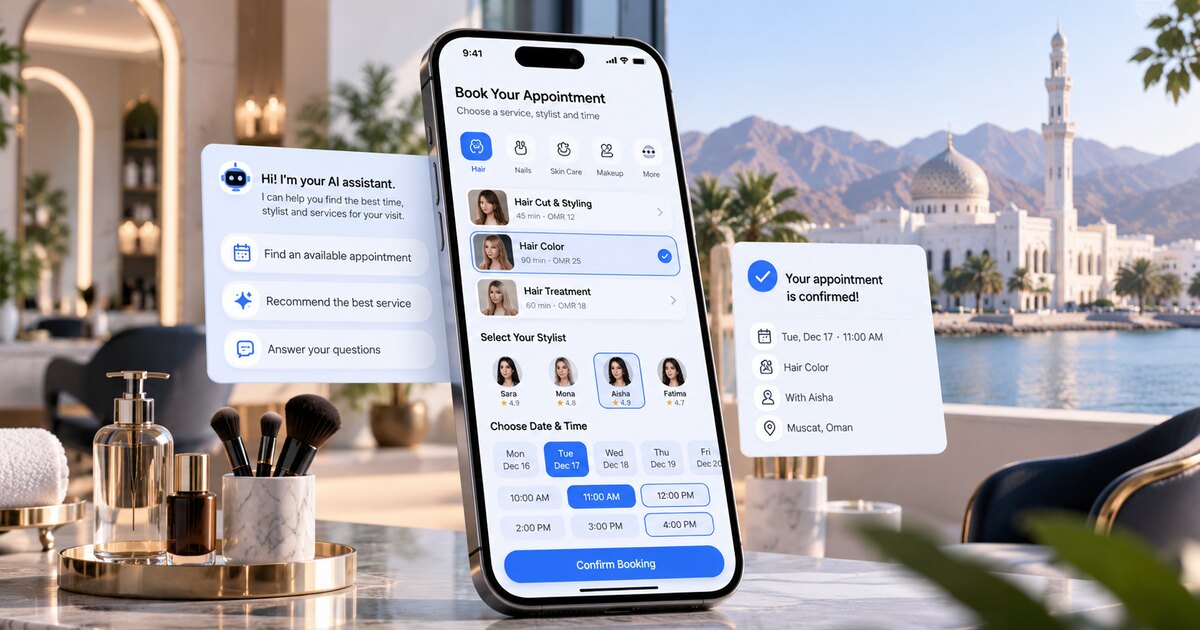
Should a beauty salon in Oman use AI for appointment booking?
For many appointment-based salons, yes — if AI is connected to a real booking system rather than used as a free-form chatbot. The useful role of AI is to understand what a client is asking, explain services, guide the client toward the right specialist or appointment type, check real availability, and help complete the booking. The calendar and business rules should remain the source of truth.
This setup can keep bookings available outside reception hours, reduce repetitive WhatsApp conversations, make service selection clearer, and create a cleaner record of each client. It is most valuable when a salon already receives a meaningful number of booking questions through WhatsApp, Instagram, phone calls or its website.
A client decides at 10:45 p.m. that she wants a haircut on Thursday afternoon. She opens WhatsApp, asks whether a certain stylist is available, then asks how long the service takes and whether she can add a treatment. In a traditional workflow, the conversation waits until somebody is free to answer. By then, the client may have changed plans or contacted another salon.
That is the practical problem AI appointment booking is meant to solve. Not “AI” as a marketing label. Not a chatbot that invents times. A useful system connects conversation with actual salon data: services, durations, staff skills, working hours, blocked time, branch rules and available appointment slots. The client gets an immediate path forward, while the salon keeps control.
What AI appointment booking actually means
There are two different technologies that are often mixed together. The first is a booking engine: the part of the system that knows which services exist, which staff members can perform them, how long they take, when the salon is open and which time slots are free. The second is the AI conversation layer: the part that understands natural questions and helps the client navigate those booking rules.
The booking engine should decide whether 4:30 p.m. is genuinely available. AI can understand a message such as “I need something for frizzy hair after work tomorrow, preferably with Sara,” map it to the correct services, ask a useful follow-up question and then present valid options. That distinction matters because reliable salon automation needs structured data underneath it.
This also means a salon can start without making the system complicated. A first version may offer online booking, service selection, staff calendars and automatic confirmations. Later, it can add smarter conversation, a customer profile, loyalty, referrals, reminders, analytics or multi-branch controls.
Why this matters for salons in Oman
As of September 2026, structured online salon booking is already visible in Oman. Muscat Hair & Beauty Salon lets customers choose a branch, services, team member and available time. BZone lists real-time availability, reminders, rewards and Arabic/English support. Nyrevi offers salon discovery and booking across cities including Muscat, Salalah, Nizwa, Sur, Sohar and Seeb. These examples do not prove that every client expects the same workflow, but they do show that digital booking is an established part of the local customer experience.
The lesson is not that every salon needs its own mobile app. Many do not. The lesson is that clients increasingly understand the idea of seeing services, staff and availability without a long back-and-forth conversation. A salon can deliver that experience through a responsive website, a booking link, WhatsApp automation, or a combination of channels.
For Oman specifically, a strong implementation should also consider language and local presentation. A salon may serve Arabic-speaking and English-speaking clients in the same week. Prices should be clear in OMR. Branch names, service names and staff availability should be easy to understand on mobile. Communication can stay familiar — including WhatsApp — while the operational data behind that conversation becomes structured.
What a practical AI booking journey looks like
Imagine a client opens your website or messages your salon after business hours. She does not know the exact service name. She types: “I colored my hair two months ago and I want to fix the dryness. Can I come Thursday evening?”
Understand the request
The assistant identifies that the client is asking about hair care and an appointment, not simply requesting a price list.
Clarify what matters
It may ask one or two targeted questions: hair length, preferred branch, whether she wants a consultation first, or whether a specific stylist is required.
Use real salon rules
The system checks services, duration, staff capability and live calendar availability. It does not promise a time that is already occupied.
Offer valid options
The client sees two or three useful choices rather than a wall of unrelated services and every time slot in the week.
Confirm and record
The appointment is saved, the customer receives confirmation, and the salon has a clean booking record instead of a message buried in a chat thread.
Continue the relationship
Before the appointment, the system can send an approved reminder. After the visit, it can support feedback, loyalty and a sensible next-booking journey.
This is where AI becomes useful: not as a magic feature, but as a flexible interface between the way humans naturally ask questions and the way a scheduling system needs information to be structured.
Seven business benefits that matter more than the “AI” label
1. Booking can continue when the front desk is unavailable
A salon's physical working hours and its booking hours do not need to be identical. Clients often think about appointments while commuting, at home or late in the evening. A structured booking system can remain available without requiring an employee to stay online. AI adds value when the client needs guidance before choosing a service or time.
2. Your staff spend less time answering the same questions
“How much is this service?” “How long does it take?” “Who is available?” “Do you have a slot tomorrow?” These are legitimate questions, but they repeat. When prices, durations, policies and calendars are structured, routine questions can be answered consistently. Staff can focus on exceptions, consultations and clients who need human judgment.
3. Fewer booking mistakes and double entries
Manual scheduling across WhatsApp, calls, Instagram DMs and a paper or spreadsheet calendar creates opportunities for mistakes. The real improvement comes from having one source of truth for availability. AI should read from that source instead of creating a second parallel calendar.
4. Clients can choose with more confidence
Service menus can be confusing, especially when several treatments sound similar. A conversational layer can explain the difference in plain English or Arabic, ask what result the client wants, and then direct her toward the right category. For higher-risk or highly technical services, it should recommend a consultation rather than making a confident diagnosis.
5. The salon builds a useful client record
A booking should not disappear after the appointment. Over time, the salon can build a structured client profile: previous services, preferred branch, preferred specialist, notes that staff are authorized to keep, visit history and loyalty status. This supports better continuity without forcing the client to explain everything again on every visit.
6. Reminders and follow-up become systematic
A booked appointment is only useful if the client remembers it. A smart workflow can send a confirmation immediately and an approved reminder at the right time. This connects directly to the next guide on reducing salon no-shows with smart reminders. The important point is to make reminder timing and consent part of the system, not an improvised manual task.
7. Management gets cleaner operational data
Once bookings happen in a structured system, the owner can answer better questions: Which services are most requested? Which hours are underused? How far in advance do clients book? Which staff calendars fill fastest? How many clients return? Good reporting does not require “AI” everywhere; it requires clean data first. AI can later help summarize or interpret that data.
AI receptionist vs human receptionist: the wrong comparison
The strongest salon setup is usually not “AI instead of people.” It is AI for repetitive, structured work and humans for judgment, trust and exceptions.
A human receptionist is better at reading unusual situations, handling a sensitive complaint, negotiating a complex reschedule, understanding a long-standing VIP client, or recognizing when a service requires a professional consultation. An AI assistant is better at being available at midnight, repeating a policy without fatigue, searching structured information quickly and guiding a standard booking flow consistently.
That division of work makes the experience feel more human, not less. When automation handles routine traffic, your staff can spend their attention on the conversations where attention actually matters.
- Opening hours and location
- Service descriptions and approved prices
- Available slots
- Standard booking and cancellation steps
- Confirmations and consent-based reminders
- Complex consultations
- Complaints and recovery
- Unusual service combinations
- Special customer arrangements
- Anything requiring professional judgment
Does WhatsApp still matter if you have a booking system?
Yes. In fact, forcing clients to abandon the channel they already use can be a mistake. The better question is: what should WhatsApp do, and what should the booking system do?
WhatsApp is excellent for conversation. A booking system is excellent for structure. The system knows availability, appointment status, service duration and customer records. WhatsApp can be one of the interfaces through which clients ask questions, receive a booking link, get a confirmation or contact staff.
This is why we treat WhatsApp versus a booking system as a separate topic. A salon does not have to choose one and delete the other. The goal is to stop important booking data from living only inside message threads.
How to implement AI booking without overbuilding
A salon does not need every possible feature on day one. A cleaner implementation usually happens in stages.
Stage 1: Clean the service and scheduling data
List every bookable service, its normal duration, price or price rule, which staff can perform it, branch availability, buffers, working hours and cancellation rules. If this information is inconsistent, AI will only make inconsistency faster.
Stage 2: Create a reliable booking flow
The client should be able to select or discover a service, choose a staff member when relevant, see valid times, submit details and receive a clear confirmation. It must work properly on mobile. This stage alone can already remove a large amount of manual coordination.
Stage 3: Add approved automation
Add confirmations, reminders, reschedule logic and staff notifications. Decide which messages require consent and make the rules visible. Keep a clear audit trail so the team knows what the system sent.
Stage 4: Add AI where natural language helps
Now AI can answer approved FAQs, interpret customer intent, recommend relevant service categories and collect the information needed for booking. The AI should be constrained by the salon's live data and should know when to hand a conversation to a person.
Stage 5: Connect retention features
Once the booking experience is stable, add features that improve the relationship after the appointment: a customer loyalty program, referral rewards, visit history, personalized follow-up and eventually AI-assisted repeat-customer campaigns.
Common mistakes to avoid
Letting AI invent availability
The assistant should never “guess” that a stylist is available. Availability must come from the scheduling system.
Automating a messy service menu
If your team uses different names, durations or prices for the same service, fix the data first. Automation depends on consistency.
Forcing every client through a long chatbot conversation
Some customers already know exactly what they want. Give them a fast booking path. AI should reduce friction, not create a new obstacle.
Hiding the human escape route
Clients should always have a clear way to reach a person when the request is unusual or sensitive.
Collecting more personal data than you actually need
Client profiles can be valuable, but data collection should have a clear purpose. Keep access controlled, avoid unnecessary notes and design retention/privacy rules before the database becomes large.
Buying a generic tool before understanding your workflow
For a simple single-location salon, an off-the-shelf scheduler may be enough. Custom development becomes more useful when the business has specific service logic, multiple branches, custom loyalty rules, integrations, unique reporting or a branded customer journey. The right answer depends on the operation, not on what sounds more advanced.
What should a salon owner measure after launch?
A smart system should make performance easier to measure. Start with a few metrics that connect directly to operations rather than chasing vanity numbers.
- Online booking share: how many appointments are completed without manual scheduling?
- Booking completion: where do clients abandon the flow?
- Response coverage: how many routine questions can be answered from approved salon data?
- Reschedule and cancellation patterns: when and why do appointments change?
- No-show trend: does a better confirmation/reminder workflow improve attendance over time?
- Repeat booking: how many first-time clients return within a meaningful service cycle?
Do not promise yourself a specific percentage improvement before you have a baseline. Measure the salon before the new flow, launch carefully, and compare the same metrics afterward. That is a much stronger business case than repeating generic AI statistics from the internet.
Who benefits most from AI-assisted booking?
The value tends to be strongest for salons that receive many repetitive inquiries, offer a large service menu, have several staff members or specialists, operate more than one branch, or receive booking messages outside working hours. It can also help businesses such as nail studios, barbershops, lash and brow studios, spas, skincare centers and other appointment-based wellness services.
For a very small salon with one specialist, a simple booking page may solve most of the problem. That is perfectly fine. The point is not to install AI everywhere. The point is to choose the smallest system that removes real friction today and can grow when the business needs more.

Soroush Moghaddami
Soroush Moghaddami is the founder of Filtori and an applied AI systems architect with a background in database engineering, software systems and business automation. His work focuses on turning AI into practical workflows connected to real operational data rather than isolated demos.
View Soroush Moghaddami's English profile →AI appointment booking FAQ
Can AI book salon appointments automatically?
Yes, when it is connected to a real booking engine. AI can understand the client's request and guide the conversation, while the booking engine validates staff, service duration and actual availability before confirming an appointment.
Does AI replace the salon receptionist?
It does not need to. A practical system automates repetitive questions and standard booking steps while keeping staff available for consultations, exceptions, complaints and high-value customer conversations.
Can an AI booking system work with WhatsApp?
Yes. WhatsApp can remain a customer communication channel while a structured booking system manages services, calendars and appointment records. The exact integration depends on the salon's workflow and the approved messaging setup.
Should an Oman salon offer Arabic and English?
If the salon serves both Arabic-speaking and English-speaking clients, a bilingual customer journey can reduce friction. Service names, important policies and booking messages should be reviewed by humans rather than relying on uncontrolled automatic translation.
Can prices be shown in OMR?
Yes. A salon system designed for Oman should present customer-facing prices in Omani rials where appropriate and keep price rules consistent across the booking journey.
What information should the AI be allowed to answer?
Ideally, only approved salon information: services, prices or price rules, durations, staff capabilities, branch details, opening hours, booking policies and live availability. If information is uncertain, the assistant should hand the conversation to a person instead of inventing an answer.
Do I need a mobile app?
No. Many salons can provide an excellent mobile experience through a responsive website, booking page and messaging integration. A dedicated app makes sense only when it adds enough ongoing value for customers to justify the extra adoption and maintenance.
What should a salon automate first?
Start with reliable online booking and a clean staff calendar. Then add confirmations, reminders and customer profiles. Add AI after the core data is trustworthy, so the assistant has accurate information to work with.
Examples referenced in this guide
These sources were reviewed in September 2026 to verify the market examples used above. They show how digital salon booking is presented to customers in Oman and are included as references, not endorsements.
Want to see what this could look like for your salon in Oman?
We can map your current booking process, identify the repetitive work worth automating, and design a customized flow for your services, staff, customers and brand. Start simple, then add loyalty, profiles, AI and reporting when they make sense.