
Why Every Salon Client Should Have a Personal Profile
A good salon client profile is not a digital address book. It is the place where booking history, service preferences, packages, loyalty, communication choices and useful service notes come together — so the client does not have to start from zero every time she returns.
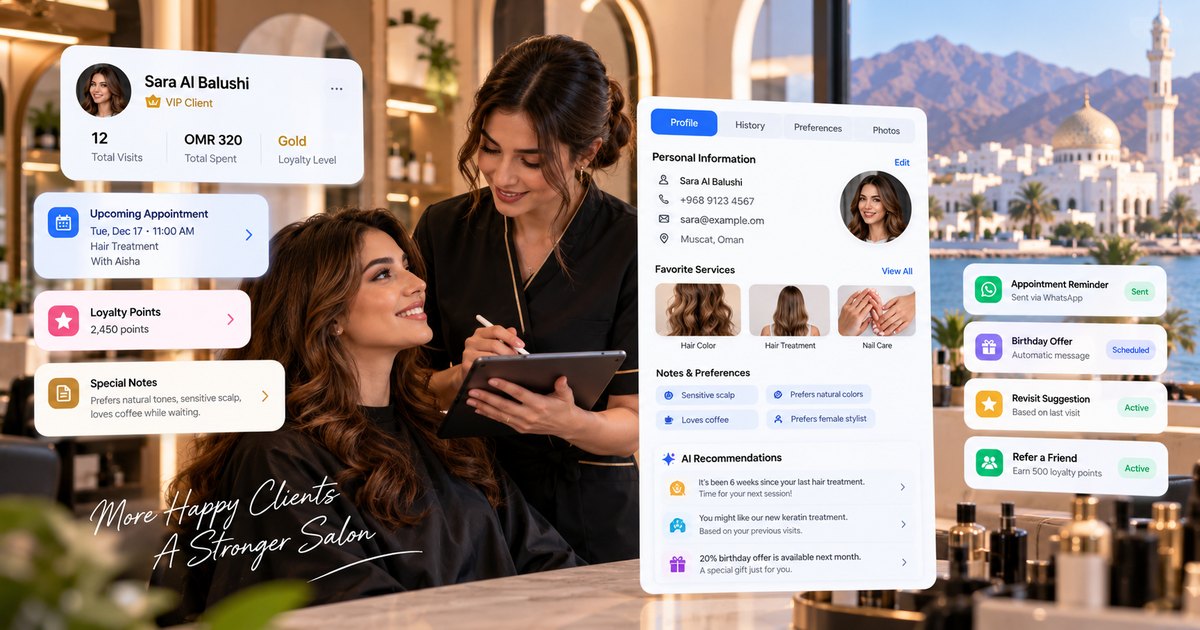
Why should every salon client have a personal profile?
Because a salon relationship is built across visits, not in one appointment. A structured client profile lets the salon remember what happened before, what the client prefers, what package or reward is still active, how she wants to be contacted and what information staff genuinely need for the next service.
For the client, that means less repetition and a smoother experience. For the salon, it means cleaner operations, more consistent service, easier follow-up and better data for booking, loyalty and retention. The key is to collect only useful information, keep it accurate, control who can see it and respect Oman’s data-protection requirements.
A salon client profile is not a social-media profile
When salon owners hear “client profile,” the phrase can sound more complicated than it is. It does not mean building a public page about the customer. It does not mean collecting every possible detail. It does not mean asking staff to write long reports after each appointment.
A useful salon profile is simply a structured record tied to one real client. It brings together the pieces of information that otherwise end up scattered across WhatsApp chats, paper notebooks, reception spreadsheets, individual stylists’ phones and the memory of whoever happened to be on shift.
Think about a regular client who books color every six weeks. Her last appointment was with one stylist, the visit before that was at another branch, she still has one session in a package, she prefers late-afternoon appointments and she has already earned a loyalty reward. If those facts live in five different places, the salon technically “has” the information but cannot use it reliably.
A proper profile makes those pieces visible in one place. The receptionist can see the upcoming booking. The authorized stylist can see relevant service history. The customer can see her own appointments, packages or rewards. The system can use the same record to avoid duplicate accounts, apply the right loyalty rule and send an approved reminder when appropriate.
Salon service depends on memory more than many businesses realize
A café can serve a customer well without remembering what she ordered three months ago. A salon often cannot deliver the same level of continuity that way. Beauty services are personal, recurring and often connected to earlier decisions. Hair color, treatment packages, nail services, facials, lashes and similar appointments create a history that can matter to the next visit.
This is where many salons run into an invisible growth problem. When the owner knows every customer personally, memory works. When there are more clients, more staff, more branches and more booking channels, memory stops scaling. Information becomes dependent on one person. If that person is off, busy or leaves the business, part of the customer relationship disappears with them.
A profile turns personal memory into an operational system. It does not replace the human relationship. It protects it. A stylist can still greet the client naturally, ask questions and use professional judgment. The system simply makes sure the basics are not lost between visits.
It helps the salon recognize a returning client as a returning client
This sounds obvious, but duplicate accounts are common when a person books once by phone, once through WhatsApp and later online with a slightly different name. A consistent mobile number or verified account can help the system match the person to one record. That means visit history, package balance and loyalty activity stay together rather than splitting into several profiles.
It reduces repeated questions at reception
Clients should not have to repeatedly explain which branch they usually visit, whether they have a package session remaining, which stylist they normally book or whether they already paid a deposit. When information is structured, staff can confirm rather than rediscover it.
It gives staff context without turning service into guesswork
Good service is not “the system says you like this, so we will do it again.” Preferences change. A client may want something completely different today. The profile should provide context, not make the decision. The professional still asks, confirms and adapts.
Why client profiles make sense for modern salons in Oman
The salon market in Oman is already moving beyond appointment books. As of September 2026, local booking products show that clients are becoming familiar with accounts, online bookings, package tracking, loyalty status and appointment history. Muscat Hair & Beauty Salon, for example, lets users book by branch, service, team member and time through an account-based flow. Its mobile app describes access to upcoming and past visits, package-session tracking and Member or VIP status. BZone promotes booking, reminders and rewards for salons across Oman.
That matters because the question is no longer whether salon customers in Oman can understand a digital account. The more useful question is: what should that account remember, and how should the salon use that information responsibly?
Oman also adds practical design considerations. A salon may serve Arabic- and English-speaking clients. It may operate more than one branch. Clients may book through a website, app, Instagram, WhatsApp or reception. A strong profile should connect those entry points without forcing the customer to create a new identity every time.
For a salon targeting premium service, the profile also supports something more subtle: continuity. A client who visited the Muscat branch last month and a different branch this month should still feel recognized where appropriate. She should not lose her package history simply because the booking happened through another channel.
What should a salon client profile actually contain?
The best profile is not the one with the most fields. It is the one with the right fields. Every item should have a clear operational purpose. If staff cannot explain why the salon needs a piece of information, it probably should not be collected.
1. Basic identity and contact details
Name, verified mobile number and an email address where useful are usually enough to identify the client and support bookings. If your system supports Arabic and English, store the customer’s preferred communication language rather than guessing it later. A profile may also include a preferred contact channel if the client has explicitly chosen one.
2. Appointment history
A clean timeline of completed, upcoming, cancelled and no-show appointments is one of the most useful parts of the profile. Each entry should show the branch, service, date, staff member and booking status. This history helps reception understand the relationship quickly and helps management see actual patterns without reading chat logs.
3. Service history
Appointment history tells you that a visit happened. Service history can go one level deeper where it is genuinely useful. It may record which service was completed, which option or package was used, and relevant operational notes. For technical services, the salon may decide to store carefully limited formulation or treatment information if it has a clear purpose and the right controls.
4. Stated preferences
Preferences should come from the client or from repeated confirmed choices — not from stereotypes. Examples include a preferred branch, a stylist the client asks for, quiet appointments, a preferred appointment window, or communication language. These are small details, but they can remove friction on the next booking.
5. Packages, prepaid sessions and balances
If a customer buys a multi-session package, the profile should make the balance obvious: total sessions, sessions used, sessions remaining, purchase date and expiry rules. The client and the salon should see the same underlying count. This prevents the awkward situation where reception believes two sessions remain while the client believes there are three.
6. Loyalty and referral activity
The profile should connect to the salon’s loyalty program: points earned, points redeemed, VIP tier, referral code, eligible rewards and the event that triggered each reward. This makes the program auditable instead of relying on manual promises in chat.
7. Communication permissions and preferences
A customer who agrees to appointment reminders has not necessarily agreed to every marketing campaign. Keep operational communication and promotional communication clearly separated. The profile should make consent and opt-out status visible so staff and automated systems know what can be sent.
8. Relevant service notes
Notes can be useful, but they are also where systems become messy. A good note is factual, short and related to service continuity. A bad note is judgmental, speculative or unrelated to the salon relationship. Staff should never use the profile as a private commentary wall about customers.
9. Before-and-after media, only where appropriate
Some salons use photos to document work, compare progress or show a client the result of a treatment plan. If you store images, the system should distinguish between images kept for service records and images the salon is allowed to publish for marketing. Permission to keep a service photo is not automatically permission to post it on Instagram.
10. Privacy and account controls
The profile should not only store data; it should help manage that data. Depending on the system and legal requirements, clients may need ways to review information, correct details, manage communication preferences or request deletion where applicable. Internally, the salon should be able to see who has access and why.
A profile is better than scattered notes — but only if staff actually trust it
Many salons already have pieces of a client profile, just not in one system. A receptionist has a spreadsheet. A stylist has photos on her phone. The owner remembers the VIP clients. WhatsApp contains the booking conversation. A paper card contains notes from a previous service. Each source may be useful on its own, but together they create contradictions.
- Different answers depending on who is working
- Hard to find old appointments quickly
- Packages and rewards can be disputed
- Information may stay on personal devices
- Duplicate customer records appear easily
- Automation has no reliable source of truth
- One record across booking channels
- Clear appointment and service timeline
- Packages and rewards tied to real events
- Role-based access for authorized staff
- Cleaner consent and communication status
- Reliable foundation for reminders and AI
The important part is adoption. If the official system is slow or confusing, staff will return to WhatsApp notes and personal memory. That is why the interface matters. A profile should answer common questions in seconds: Who is this client? What is her next appointment? What did she book last time? Is there a package balance? Is there a reward? What do we need to know before the visit?
How one client profile should follow the customer from first booking to repeat visit
The strongest argument for a client profile becomes clear when you follow one customer through the whole journey. Imagine Mariam discovers a salon in Muscat through Instagram. She has never visited before and wants a hair treatment next Tuesday evening.
First booking
Mariam opens the salon’s booking page, chooses the service, branch and available time, and creates a simple account with the minimum details required. Her first appointment becomes the beginning of one profile — not a separate record that will be forgotten after the visit.
Before the appointment
The system sends the operational confirmation and an approved reminder. Reception sees the same booking. If a deposit is required, its status is linked to the appointment instead of being buried in a screenshot inside WhatsApp.
During the visit
Authorized staff can see the service booked and add only the notes needed for future continuity. If Mariam purchases a three-session package, that package is attached to the same client record.
After completion
The appointment moves to completed status. Loyalty points or visit credit are applied according to the salon’s rules. The package balance changes from three sessions to two only if that session was actually used.
Return timing
If the service has a normal return window and Mariam has consented to appropriate communication, the system can later support a relevant reminder. It does not need to guess randomly; it has the service date and her own history.
Second booking
When Mariam returns, the system already knows her account, remaining package sessions, previous branch and loyalty status. She can still choose something different, but she does not have to rebuild the relationship from the beginning.
This is what makes a profile valuable: not a pretty dashboard, but continuity across real events. Booking creates data. The visit confirms what actually happened. Loyalty uses the completed event. Follow-up uses the same history. Management sees the same underlying record.
Where AI can help once the client profile is reliable
AI is much more useful when it works with structured, permissioned salon data instead of reading an unorganized pile of messages. A profile gives the system context. That does not mean the AI should be allowed to make every decision. It means it can assist staff and clients with information that already exists.
AI can summarize a long relationship quickly
A receptionist does not need to scan twelve old appointments to understand a returning client. An assistant could produce a short operational summary: “Six completed visits this year, usually books hair treatment at the Qurum branch, one package session remaining, Gold loyalty tier, next appointment Thursday at 5:30 PM.” Every statement should come from stored data and ideally link back to the underlying record.
AI can make booking conversations more useful
In our guide to AI appointment booking for salons in Oman, the assistant helps a client find a suitable service, staff member and available slot. A connected profile makes that conversation better. If the client is logged in, the system can recognize an unused package or show an existing booking before creating another one.
AI can support repeat-customer timing
The profile records when services were completed. That creates a foundation for intelligent follow-up. A salon does not need to message everyone every week. It can identify clients whose normal service cycle suggests that a return may be relevant, then use clear business rules and consent settings before sending anything. We explore that in more detail in how AI can help salons bring repeat customers back.
AI can help staff search without memorizing the database
An owner may want to ask, “Which clients have an unused keratin package and no future booking?” or “How many VIP clients visited the Al Khuwair branch this month?” A well-designed system can translate that question into a structured search. The AI should retrieve facts; it should not invent them.
AI should not make sensitive assumptions
A client profile is not permission to infer private characteristics. The AI should not guess health conditions, income, religion, personal relationships or other sensitive information. Personalization should stay close to the salon relationship and the data the client or staff legitimately provided for that purpose.
Client profiles in Oman must be designed with privacy and consent in mind
A customer profile can improve service, but it also creates responsibility. Oman has a dedicated Personal Data Protection Law, and in September 2026 Royal Decree 68/2026 amended several provisions. The Ministry of Transport, Communications and Information Technology (MTCIT) explains that organizations have obligations around consent, data-subject rights, privacy policies, processing records, marketing communications and data breaches.
The law is a legal matter, so salons should obtain qualified local advice for their exact setup. From a product-design perspective, however, several practical principles are clear enough to guide a safer system.
Tell clients what you are collecting and why
Consent should not be hidden behind vague language. If a salon wants to store a date of birth for birthday benefits, explain the purpose. If it wants to keep before-and-after photos as part of a service record, explain that separately. If it wants permission to use an image for marketing, that is a different purpose and should not be bundled carelessly with service delivery.
Separate service communication from marketing
A booking confirmation and a promotional campaign are not the same thing. MTCIT’s guidance states that consent is required before sending advertising or commercial marketing material, with an opt-out mechanism. A salon system should therefore record marketing permission explicitly rather than treating every phone number in the database as a campaign list.
Do not keep data forever just because storage is cheap
The 2026 amendments include provisions on erasing personal data when the purpose of processing has ended, subject to legal exceptions. Operationally, this means the salon should have a retention approach. Old inactive profiles should not simply accumulate forever without any policy.
Automated processing needs safeguards
The amended law also addresses automated processing and the need for privacy and confidentiality measures. If a salon later uses AI to segment customers, recommend actions or make automated decisions, the product should be designed so those actions can be reviewed and challenged where required. Human oversight is not an optional decoration when automation affects people.
Not every employee needs access to the entire client profile
One of the biggest mistakes in small business software is giving every staff member the same access because it is easier to build. It is easier — until someone sees information they did not need, exports customer data, edits a package balance incorrectly or leaves the company with a complete client list.
A salon profile should support role-based access. Reception may need contact details, booking history, package status and payment/deposit information. A stylist may need the upcoming service and relevant service notes. A branch manager may need reporting and operational history. The business owner may need broader oversight. Marketing staff may only need approved segments, not every private note.
Client-visible information and internal information should be separated
The customer’s own profile might show appointments, package balance, loyalty points, referral status, preferred branch and communication settings. Internal service notes may be visible only to authorized salon staff. This separation makes the interface cleaner and reduces the chance that an internal operational field appears where it should not.
Changes should be traceable
If a package balance changes manually or a loyalty reward is adjusted, the system should record who changed it and when. The same principle applies to important profile edits. Audit history is especially useful when multiple branches or managers share the system.
Personal devices should not become the unofficial database
If staff need to take service photos or notes, the workflow should move them into the authorized system quickly and safely, rather than leaving the salon’s customer records scattered across personal phones. This is both an operational and privacy issue.
The client should benefit from the profile too
Too many CRM systems are built entirely for the business. The customer provides information, but receives no visible benefit. A strong salon profile should make the client’s own life easier.
- See upcoming appointments: date, time, branch, service and specialist in one place.
- Review past visits: useful for rebooking a familiar service without searching old messages.
- Track package sessions: how many were purchased, used and remain.
- View loyalty and referral status: points, tier, available rewards and referral credit.
- Manage communication preferences: where the system supports it, choose relevant notifications and marketing consent.
- Update basic details: reduce the need to call reception for every account change.
- Book again quickly: the profile becomes a launch point for the next appointment, not a dead account page.
This is also where mobile design matters. Most salon clients will not sit at a desktop computer to manage their account. The profile should load quickly on a phone, keep important information near the top and avoid forcing the user through a complex dashboard designed for managers.
How to implement salon client profiles without making the system heavy
You do not need to build a giant CRM on day one. In fact, that is usually the wrong approach. Start with the pieces that remove real friction, then add depth when staff and clients are using the basics consistently.
Phase 1: identity, booking and history
Create one reliable client record tied to a verified phone number or account. Connect upcoming and past bookings. Make sure reception can search quickly by name or mobile number. Fix duplicate-profile handling before adding advanced personalization.
Phase 2: packages, loyalty and referrals
Once appointments are reliable, connect package balances and the customer loyalty program. These features depend on completed service events, so they become much safer when the booking foundation is already accurate.
Phase 3: service continuity and controlled notes
Add structured service fields only where staff truly need them. Train the team on what belongs in a client note and what does not. Avoid free-text fields everywhere; structured choices are easier to search, report and control.
Phase 4: reminders and customer-return workflows
Connect the profile to appointment reminders and return timing. Our upcoming guide on reducing salon no-shows with smart reminders covers the scheduling side, while the repeat-customer guide focuses on bringing people back at the right time.
Phase 5: AI on top of clean data
Only after the underlying records are trustworthy should you add AI summaries, natural-language search, personalized recommendations or automated segmentation. AI is the final layer, not the foundation.
How do you know whether client profiles are actually helping?
Do not measure success by the number of profile fields completed. Measure whether the salon works better and the client journey becomes easier.
- Repeat booking rate: are more clients returning over a meaningful period?
- Profile duplication rate: how often does the same person end up with multiple records?
- Package discrepancy rate: how often do clients and staff disagree about remaining sessions?
- Booking time: can reception or the client complete a repeat booking faster?
- No-show and late-cancellation patterns: can the profile and reminder history help staff understand what is happening?
- Consent quality: can the salon clearly identify who has agreed to promotional communication and who has not?
- Staff adoption: are employees using the profile, or are they still maintaining shadow notes elsewhere?
- Data freshness: are phone numbers, preferences and package statuses being updated rather than left stale?
These measurements reveal whether the system is becoming a real source of truth. A beautiful profile screen that staff do not trust is a design failure, even if it looks impressive in a demo.
Common mistakes salons make when building client profiles
Collecting too much information at signup
Every extra field adds friction. A first-time customer who only wants to book a haircut should not face a twelve-question registration form. Ask for the minimum needed to create the account, then collect additional information only when it becomes relevant and there is a clear purpose.
Using free-text notes for everything
Free text feels flexible, but it becomes impossible to report consistently. Use structured fields for things like preferred branch, package status and marketing consent. Reserve notes for information that genuinely cannot be represented another way.
Mixing facts with opinions
“Prefers appointments after 4 PM” is useful. “Difficult client” is not. Internal notes should be professional, factual and related to service delivery.
Giving every employee full access
Convenience is not a good reason for unlimited access. Design roles around actual job needs and review access when staff responsibilities change.
Forgetting the customer view
If the profile only helps management, the client receives little reason to keep the account. Show useful information such as bookings, package balance and rewards where appropriate.
Using the profile as permission to over-message
More data does not justify more messages. Communication should stay relevant, consent-based and easy to stop. Otherwise the same system designed to improve loyalty can create annoyance.
Adding AI before the data is trustworthy
An AI summary of bad data is still bad data. Clean duplicates, booking statuses, package balances and consent records first. Then automate.
Keeping everything forever
Retention needs rules. Profiles should not become permanent storage for information that no longer has a purpose. Review your legal and operational retention requirements and implement them deliberately.
What a 10/10 salon client profile should feel like
From the client’s perspective, it should feel almost invisible. She books, returns, sees her package, finds her next appointment and receives relevant communication without thinking about the database behind it.
From reception’s perspective, it should feel fast. Search a name or number, understand the relationship, resolve a package question, see the next appointment and make a new booking without opening several apps.
From the owner’s perspective, it should feel dependable. The same client history should feed booking, loyalty, reporting and follow-up. Branches should not have competing versions of the truth. Sensitive information should not be visible to everyone. Important changes should be traceable.
And from an AI system’s perspective, the profile should be structured enough that it can retrieve facts safely. That is what separates useful personalization from guesswork.
The profile is therefore not an “extra feature” sitting beside the salon system. It is the connective layer between the parts that matter: booking, loyalty, reminders, packages, referrals, service continuity and repeat business.
Salon client profile FAQ
What is a salon client profile?
A salon client profile is a structured record connected to one customer. It can include contact details, appointment and service history, packages, loyalty activity, stated preferences, relevant service notes and communication permissions. Its purpose is to create continuity between visits, not to collect unnecessary personal information.
Why is a client profile better than keeping notes in WhatsApp?
WhatsApp is useful for communication, but it is not a reliable customer database. Important information becomes buried in conversations, package balances are hard to audit and different staff may not have the same context. A structured profile keeps operational facts in one controlled record while WhatsApp remains a communication channel.
What information should a beauty salon store about a client?
Store only information with a clear purpose: basic identity and contact details, bookings, completed services, package balances, loyalty and referral activity, stated preferences, communication settings and limited service notes where genuinely needed. Avoid collecting unrelated or speculative personal information.
Should clients be able to see their own salon profile?
Usually they should be able to see the parts that help them: upcoming and past bookings, packages, loyalty status, basic account details and communication preferences where supported. Internal operational notes may require separate staff-only access. The exact design should follow the salon’s workflow and privacy obligations.
Can AI use a salon client profile?
Yes, if the data is accurate, authorized and relevant. AI can summarize visit history, help staff search records, support booking, identify unused packages or assist with approved follow-up. It should not invent facts, make sensitive guesses or bypass privacy and consent rules.
How can a client profile help with loyalty programs?
The profile connects rewards to real customer activity. It can show points earned, redemptions, VIP tier, referrals and package usage. Because rewards are tied to completed visits and one customer identity, the salon can apply rules more consistently and resolve disputes more easily.
Does Oman have rules about storing salon customer data?
Yes. Oman has a Personal Data Protection Law and Executive Regulations, and Royal Decree 68/2026 amended several provisions in September 2026. MTCIT publishes official guidance on consent, data-subject rights, privacy policies, marketing communications, processing records and other obligations. Salons should obtain appropriate legal advice for their specific setup.
Should every salon employee see the full profile?
No. Access should follow job responsibilities. Reception, stylists, branch managers, marketing staff and owners may need different information. Role-based access reduces unnecessary exposure and makes it easier to control sensitive operational data.
Can one client profile work across multiple salon branches?
Yes, and that is one of its strongest uses. A central profile can keep bookings, packages and relevant history connected across branches while still respecting role and branch access. The customer should not lose her record simply because she books a different location.
What should a salon build first: booking, client profiles or AI?
Start with reliable identity and booking, then connect the client profile and appointment history. Add packages, loyalty and reminders next. AI works best after the underlying records are accurate and staff already trust the system.
References used for the Oman-specific parts of this guide
- Muscat Hair & Beauty Salon — online booking flow, accessed September 2026.
- Muscat Hair & Beauty Salon — Oman App Store listing, describing appointment history, package tracking and Member/VIP status.
- BZone — salon partner platform in Oman, describing booking, staff tools, WhatsApp reminders, analytics and loyalty.
- Oman MTCIT — Personal Data Protection guidance, including controller obligations, consent and marketing opt-out guidance.
- Oman MTCIT — Royal Decree 68/2026, published September 6, 2026.

Soroush Moghaddami
Founder of Filtori and an applied AI systems architect focused on business automation, databases and practical software systems. His work includes custom booking, customer-management and AI-assisted operational platforms.
View the English author profile →Want a client profile that is actually connected to the rest of your salon?
We can map your booking flow, customer records, staff access, packages, loyalty, reminders and AI features into one customized system designed around the way your salon really operates.