
How Smart Appointment Reminders Can Reduce Salon No-Shows
A missed appointment is rarely just an empty chair. It is reserved staff time, a service that could have been sold to someone else, and a schedule that becomes harder to manage. Smart reminders help because they do more than say “don’t forget”: they make it easy to confirm, reschedule or cancel before the slot is lost.
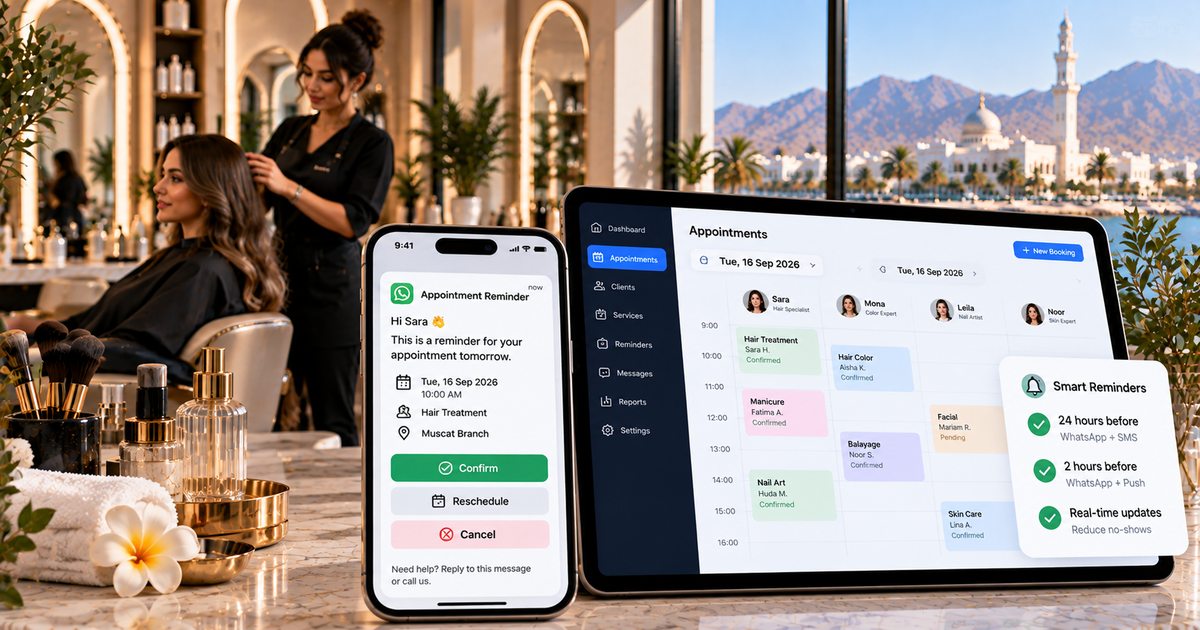
How can salons reduce no-shows?
Use a reminder system that is connected to the live booking calendar and gives the client a clear next action. The strongest workflow confirms the appointment immediately, sends a reminder before the visit, and lets the client confirm, reschedule or cancel without starting a long conversation. For salons in Oman, WhatsApp can be an excellent delivery channel, but the booking system — not the chat thread — should remain the source of truth.
Reminders are not a guarantee. People still get sick, traffic changes, family plans shift and some clients simply forget. The goal is to reduce avoidable no-shows and convert last-minute uncertainty into earlier cancellations or reschedules that the salon can manage.
A no-show is not just an empty chair
Imagine a colour appointment that reserves one stylist for three hours. The client booked several days ago, the slot disappeared from the calendar, other customers were offered different times, products were prepared, and the team planned the day around that visit. At 2:00 PM, the client does not arrive. At 2:15, reception sends a message. At 2:30, the team accepts that the booking is lost.
The obvious loss is the service revenue. The less visible loss is the opportunity cost. A client who wanted that time yesterday could not book it. A staff member now has a gap that may be too large to fill but too short to use efficiently. If the service included several staff members or a private room, the disruption spreads further.
This is why salons should separate three events in their reporting: timely cancellation, late cancellation and no-show. A timely cancellation can often be resold. A late cancellation may still hurt, but at least the salon knows what is happening. A true no-show gives the team neither the client nor enough notice to recover the slot.
It is “How do we help clients tell us sooner when their plans have changed?” That produces better operations and usually a better customer experience.
Why reminders work: they reduce forgetfulness and create a decision point
There is strong evidence that appointment reminders improve attendance in healthcare settings. A meta-analysis of SMS reminders found higher attendance among people who received reminders, while another systematic review of digital notifications reported lower no-show rates for notified groups than for groups receiving no notification. These studies are not salon studies, so a beauty business should not copy the exact percentages and promise the same result. But they support the underlying idea that timely notifications can change appointment behaviour.
The mechanism is simple. A booking made a week ago is no longer at the front of someone’s mind. A reminder puts it back there. If the appointment still works, the client confirms. If it does not, the client has an opportunity to move or cancel it before the slot is wasted.
Research also suggests something operationally important: reminders work better when the system makes response easy. Reviews of appointment systems have found that reminders can encourage cancellation or rescheduling when people realize they cannot attend. From a salon’s perspective, that can be a success. A cancellation received in time can be offered to a waitlist, posted to available slots, or picked up by another customer.
For this reason, a salon reminder should not be written like a broadcast announcement. It should behave like a small piece of the booking interface.
“Reminder: your appointment is tomorrow at 4 PM.”
“Your appointment is tomorrow at 4 PM. Confirm, reschedule or cancel here.”
Uses the current branch, service, specialist and time — and updates the calendar immediately when the client acts.
One reminder is better than none, but the booking journey starts earlier
A strong no-show strategy begins when the appointment is created, not the night before. The client should leave the booking flow with confidence that the appointment exists and with a simple way to return to it.
1. Immediate booking confirmation
Send a confirmation as soon as the booking is created. It should include the branch, service or services, specialist if selected, date, local time, approximate duration where useful, and any deposit or arrival instruction. If the salon operates several branches in Muscat or elsewhere in Oman, the branch name and map link matter. “Tuesday at 4” is not enough when the customer may have used two locations before.
This message is less about preventing forgetfulness and more about preventing misunderstanding. Wrong branch, wrong time, wrong service duration and an incorrectly selected team member can all look like no-shows later even though the real problem started at booking.
2. A reminder early enough to recover the slot
For many salons, a reminder around 24 to 48 hours before the appointment is a sensible starting point. It gives the customer enough time to react and gives the salon a realistic chance to refill the slot if plans have changed. Long colour sessions, bridal services, packages requiring special preparation or appointments with deposits may justify earlier confirmation.
3. A light same-day reminder when it adds value
A same-day message can be useful for busy clients, appointments booked far in advance, or locations where travel time matters. It should be short. The client has already received the details, so the job is simply to bring the appointment back to attention.
Avoid treating frequency as a competition. More messages are not automatically smarter. The goal is the minimum sequence that produces clear action without making clients feel chased.
4. Real-time updates after a change
If the client reschedules, every old reminder must become obsolete. A common failure in badly connected systems is sending a reminder for the original 3 PM booking after reception moved it to 6 PM in WhatsApp. That creates distrust. The reminder engine must read from the current appointment record every time.
Reminder quality depends on booking quality
If staff calendars, service duration and client contact details are unreliable, automation only sends the wrong information faster. Start with a dependable booking flow, then automate the follow-up.
Make “I can’t come” easier than disappearing
A surprising amount of no-show prevention is not really about reminders. It is about reducing the friction of changing a booking. If cancelling requires a phone call during business hours, some customers postpone it. If rescheduling means exchanging eight messages with reception, they may wait until the last minute. A good system gives them a controlled path.
Confirm
A confirmation button tells the salon the appointment is still expected. It does not guarantee attendance, but it gives staff a clearer view of the day. It can also stop unnecessary reminder escalation for clients who have already confirmed.
Reschedule
Rescheduling should show valid future slots based on the same service duration, branch and staff rules. It should not create a second booking while leaving the first one active. Once the client selects a new time, the old slot should be released and the new appointment should receive a fresh confirmation.
Cancel
Cancellation should be simple, but it can still follow the salon’s policy. If a cancellation is inside a restricted window, the interface can explain what happens to the deposit or whether reception needs to review the request. The important point is that the policy appears before the client is confused or angry.
This is one reason WhatsApp alone is not enough as the booking system. WhatsApp is excellent for the message, but confirmation, rescheduling, cancellation and calendar updates need structured rules behind it.
Recover cancelled slots with a waitlist
The next step after making cancellation easy is to make recovery fast. When a client releases a 5:00 PM slot, the system can immediately identify people who asked for that service, branch, specialist or time window. A short availability message can go to a small waitlist rather than forcing reception to scroll through old chats and remember who wanted what.
A waitlist should not become spam. It works best when customers actively opt in for earlier appointments or preferred times. The system can then stop sending once someone takes the slot. For high-demand services, this turns a timely cancellation into an operational opportunity instead of a guaranteed loss.
This also changes how managers should think about reminder success. If reminders create more early cancellations but the salon refills most of those slots, the system is working even if the raw cancellation count rises. The useful outcome is more sellable capacity and fewer silent empty chairs.
WhatsApp can be the front door; SMS can be the safety net
For an Oman salon, WhatsApp is often a practical reminder channel because customers already use it for day-to-day communication. A reminder can contain clear appointment details and buttons or links for action. But the salon should avoid turning the reminder flow into another manual chat process. The value comes from the connection between the message and the booking record.
SMS can be useful as a fallback, especially when the salon cannot confirm delivery through its primary channel or when a client has chosen SMS. Push notifications are useful for salons with an app, but only for customers who installed it and allowed notifications. Email can work for detailed confirmations or receipts, though it is usually less immediate for a time-sensitive reminder.
The system should store communication preferences in the client profile where appropriate. That prevents one client from getting three unnecessary copies while another receives nothing.
| Channel | Best use | Main limitation |
|---|---|---|
| Fast reminders, confirmation and conversational support | Should not become the calendar itself | |
| SMS | Simple fallback and broad phone reach | Limited interface and potential messaging cost |
| App push | Rich updates for active app users | Depends on installation and notification permission |
| Detailed confirmation, policies and receipts | May be checked less frequently |
Local booking products already reflect this pattern. The Tallah Client app listing in Oman describes real-time booking management together with WhatsApp notifications and reminders, while Muscat Hair & Beauty Salon provides structured booking and appointment management in its own app. The lesson is not that every salon needs an app. It is that communication works best when it is attached to structured booking data.
Reminders and deposits solve different parts of the problem
A reminder helps when the client forgot, became uncertain or needs to change plans. A deposit changes the level of commitment. For a 20-minute service, asking every customer for a deposit may create unnecessary friction. For a four-hour colour correction, bridal package or high-demand slot, the calculation can be completely different.
Muscat Hair & Beauty Salon’s current app listing explicitly describes online deposits as part of its booking flow and also lets clients manage appointments. That combination makes sense: the client sees the full booking, understands the price, secures the slot and still has a defined way to cancel within the salon’s rules.
A good deposit policy should answer four questions before payment: how much is required, when it is refundable, what happens after a late cancellation, and whether it can be moved to a new appointment. Hiding these rules until there is a dispute does not reduce no-shows; it reduces trust.
A client can still forget a prepaid booking. Reminders protect the appointment experience; deposits protect the commercial commitment. They complement each other.
Smart reminders are based on risk and context, not spam
The phrase “smart reminder” should mean more than inserting the client’s first name. The system should understand enough context to choose a useful message and timing.
Service duration
A long treatment blocks more capacity than a quick service. It can justify an earlier confirmation or a stronger rescheduling prompt because the salon needs more time to recover the slot.
Booking lead time
An appointment created this morning for tonight may not need the same sequence as a booking created six weeks in advance. The latter has more time to be forgotten or disrupted by changing plans.
First visit versus regular client
A new client may need directions, parking guidance, arrival time, preparation instructions or a reminder of the deposit policy. A regular client may only need the essentials.
History of cancellations and no-shows
A salon can use past appointment outcomes to decide whether to request confirmation earlier or require a deposit for particular bookings. This should be implemented as a transparent operational rule, not as a hidden judgment about the person. The data should be accurate, and staff should be able to correct mistakes.
Packages and multi-session plans
If a client is using a prepaid package, the reminder can show the session being used and the remaining balance where appropriate. This reduces confusion at reception and links reminders to the same customer record used by the loyalty and retention system.
Where AI can improve reminder workflows — and where it should not
AI can help a salon decide which follow-up deserves attention. For example, a system can flag unconfirmed high-value bookings, summarize tomorrow’s uncertain appointments for reception, suggest a message in English or Arabic, or identify slots that may need a waitlist notification if they become available.
More advanced models can estimate no-show risk using operational variables such as booking lead time, service length, confirmation status and previous appointment outcomes. Evidence from healthcare research suggests predictive-model-based reminder interventions can reduce no-shows, but that evidence is still domain-specific and should not be treated as a guaranteed salon result.
The safer design is to use AI to prioritize helpful action, not to silently punish customers. A risk flag might trigger an earlier confirmation request; it should not automatically blacklist someone, change pricing without explanation or infer sensitive personal characteristics.
AI also depends on clean data. If the same customer has three profiles because one booking used +968 and another used a local-format number, the model is learning from a broken identity layer. That is why the sequence matters: reliable booking → reliable client profile → reminder automation → analytics → optional AI.
What a reminder system for salons in Oman should account for
An Oman-focused salon system should not simply copy a generic booking template. Branches, language, messaging preferences, deposits, customer data and daily operating patterns all affect how reminders should work.
Arabic and English
The reminder language should follow the client’s preference where possible. A clear bilingual experience is more useful than sending two full messages every time. Staff templates should be reviewed by people who actually communicate with customers; machine translation can assist, but awkward wording around deposits or cancellation rules can create disputes.
Branch clarity
Multi-branch salons need to show the exact location in every confirmation and meaningful reminder. Include a map link where it helps. A client arriving at the wrong branch is an operational failure even if technically she “showed up.”
Local time and schedule accuracy
Store appointment times consistently and display them in Oman local time to the customer. If the underlying infrastructure runs in another timezone, conversion should happen reliably in the system rather than being left to staff.
Data protection and messaging consent
Oman’s Ministry of Transport, Communications and Information Technology publishes guidance under the Personal Data Protection framework. The guidance states that controllers should obtain consent before processing personal data and specifically requires written consent before sending advertising or marketing material, with a documented opt-out mechanism. Royal Decree 68/2026, published in September 2026, also amended provisions of the Personal Data Protection Law, including areas related to explicit consent and automated processing.
Operational appointment reminders and promotional marketing do not serve the same purpose, but a salon should still document why it holds the customer’s contact information, how it uses it, and what communication permissions apply. Do not quietly turn a booking reminder list into a marketing list.
Track the no-show funnel, not just the final percentage
If a salon only tracks “appointments booked” and “appointments completed,” it cannot see why the gaps happen. A useful dashboard separates each stage:
- Scheduled: appointment created and expected to take place.
- Confirmed: client actively confirmed through the system.
- Timely cancellation: client cancelled early enough to meet the salon’s policy.
- Rescheduled: appointment moved and the original slot released.
- Late cancellation: client informed the salon but inside the late window.
- No-show: client did not attend and did not cancel in time.
Then segment the numbers. Is one branch worse than another? Do first-time clients miss more often than regulars? Are no-shows concentrated in services booked more than 30 days ahead? Does the rate fall after adding the 24-hour confirmation step? Does one reminder channel produce more responses?
The goal is not to build a giant analytics project. It is to find where the booking flow leaks capacity.
A simple no-show rate
A practical metric is: no-shows ÷ appointments that were expected to occur. Keep late cancellations separate so you do not hide one problem inside another. The exact business definition should be documented and remain consistent month to month.
Measure recovery too
If a reminder causes a client to cancel 30 hours early and the salon fills that slot from a waitlist, the reminder did more than reduce a no-show. It recovered capacity. Track refilled cancellations when your system can do it.
A sensible implementation plan for a salon
- Clean the booking calendar. Make sure service duration, staff availability, branches and client phone numbers are accurate.
- Send immediate confirmations. Every booking should create a clear confirmation with the correct branch, service, date and time.
- Add one reminder window. Start with a simple 24–48 hour reminder before adding complex rules.
- Add confirm, reschedule and cancel actions. Each action must update the live booking, not create a side conversation that staff later need to copy manually.
- Track appointment outcomes. Separate attended, cancelled, late-cancelled and no-show appointments.
- Test channel preference. Use WhatsApp where appropriate and add SMS or another fallback based on real delivery needs.
- Add deposits selectively. Start with long, high-value or scarce appointments rather than creating friction everywhere.
- Connect the client profile. Save communication preferences, appointment history and relevant package information in one controlled record.
- Review monthly. Compare no-shows by service, branch, lead time and reminder flow.
- Add AI last. Use it to prioritize uncertain bookings, summarize risk or assist staff only after the data is reliable.
This sequence is intentionally boring. That is a strength. A reminder system should be dependable before it becomes clever.
Salon no-shows and appointment reminders: FAQ
What is a salon no-show?
A salon no-show is an appointment where the client does not arrive and has not cancelled early enough for the salon to reuse the time. A late cancellation is different because the client does notify the salon, even if the slot is still difficult to refill.
Do appointment reminders actually reduce no-shows?
Evidence from healthcare settings consistently shows that appointment reminders improve attendance compared with no reminder. Salon owners should not copy medical effect sizes directly, but the evidence supports the basic mechanism: timely reminders reduce forgetfulness and make it easier for people to act before the appointment.
When should a salon send appointment reminders?
There is no single perfect schedule for every salon. A practical starting point is immediate confirmation when the booking is created, a reminder roughly 24 to 48 hours before the visit, and a short same-day reminder for appointments where it is useful. The best timing should be tested against the salon’s own no-show and cancellation data.
Should reminders be sent by WhatsApp or SMS?
For many clients in Oman, WhatsApp is a natural communication channel, while SMS can work well as a fallback. The important point is that the reminder should come from the booking system, use the latest appointment data, and offer a clear path to confirm, reschedule or cancel.
Should every client receive the same reminder sequence?
Not necessarily. Long or high-value appointments may justify earlier confirmation, while short routine services may need less messaging. New clients, clients with incomplete profiles and customers with a history of missed appointments can also be handled differently, provided the rules are transparent and fair.
Can deposits reduce salon no-shows?
Deposits can increase commitment for selected services, especially long appointments or services that reserve several hours of staff time. They work best when the deposit, cancellation window and refund rules are shown clearly before the client confirms the booking.
Can AI predict which salon clients may miss an appointment?
AI or rules can identify patterns such as repeated late cancellations, long lead times or unconfirmed bookings, but the goal should be to choose the right follow-up rather than label a client. Any automated processing should be designed carefully, use relevant data and respect applicable privacy obligations.
How should a salon measure its no-show rate?
Track scheduled appointments, attended appointments, timely cancellations, late cancellations and no-shows separately. A useful no-show rate is the number of no-shows divided by appointments that were expected to take place. Measure it by branch, service type, booking source and reminder flow so you can see what is actually changing.
Are appointment reminders the same as marketing messages?
Not always. A transactional message about an appointment serves a different purpose from a promotional offer. However, salons should still collect and process personal data responsibly. Oman’s MTCIT publishes official guidance on consent and requires written consent before sending advertising or marketing material, with a clear opt-out mechanism.
What is the best way for an Oman salon to start reducing no-shows?
Start with clean booking data, automatic confirmation, a clear reminder sequence, one-click rescheduling or cancellation, and a simple no-show dashboard. Then add deposits, client-specific rules and AI only after the basic workflow is reliable and measurable.
References used for evidence and Oman-specific context
- PubMed — The Effectiveness of SMS Reminders on Appointment Attendance: a Meta-Analysis. Evidence is from healthcare settings and is cited for reminder mechanisms, not as a salon-specific performance claim.
- PMC — Using digital notifications to improve attendance in clinic: systematic review and meta-analysis.
- PMC — Appointment reminder systems are effective but not optimal, including evidence on cancellation/rescheduling and reminder design.
- Oman App Store — Muscat Hair & Beauty Salon, describing deposits and appointment management.
- Oman App Store — Tallah Client, describing real-time availability, booking management and WhatsApp reminders.
- Oman MTCIT — Personal Data Protection guidance, including consent and marketing communication requirements.
- Oman MTCIT — Royal Decree 68/2026, published September 6, 2026.

Soroush Moghaddami
Founder of Filtori and an applied AI systems architect focused on business automation, databases and practical software systems. His work includes custom booking, customer-management and AI-assisted operational platforms.
View the English author profile →Want fewer empty slots without making clients feel pressured?
We can design a reminder flow around your services, branches, client profiles, cancellation policy, WhatsApp communication and booking rules — then connect it to the same system your staff already uses.