
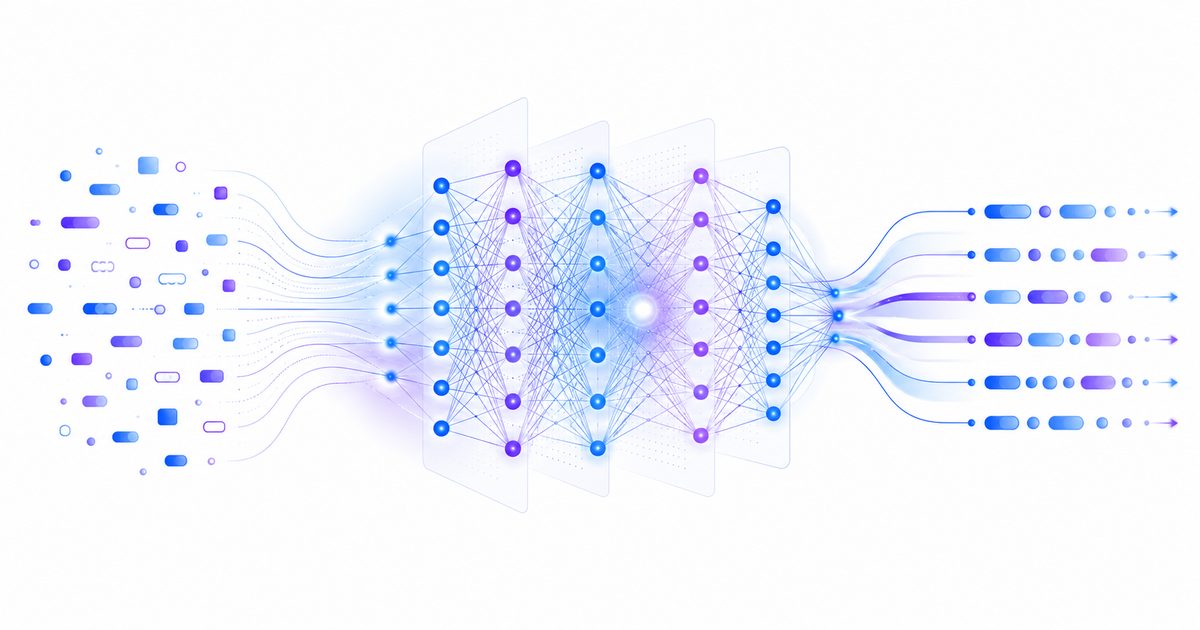
What exactly is a large language model?
Let us start with a very blunt definition: a large language model, or LLM, is a software system that has learned to guess, given a string of text, what the most probable next word is. That is it. Everything that looks like “intelligence” — writing an article, summarizing a contract, answering a customer — ultimately comes out of this one simple task: predicting the next word.
So why is it called “large”? Because these models are trained on astronomical amounts of text — books, articles, websites, conversations — and have billions of parameters; a parameter is one of those adjustable numbers that hold language patterns inside them. When we say a model has 70 billion parameters, it means 70 billion tiny numbers together decide how your next sentence should be completed.
An important point that should sink in from the start: an LLM is not a database of facts that “retrieves” answers from somewhere. The model learns the patterns of language, not a list of facts. That is why it sometimes says, with complete confidence, something that is simply wrong — a topic we will get to in detail later.
Imagine someone who has read millions of books but has no precise memory of any of them. Instead they have developed an extraordinary sense of “what usually comes after this sentence.” An LLM is exactly that person: it has a feel for language, not an archive of knowledge.
Three things a language model is not
To avoid misunderstandings from the very start, it helps to know what an LLM is not. These three misconceptions are the most common reason people get disappointed with this technology:
- It is not a search engine. Google finds an already-existing document and shows it to you. A language model does not find anything; it generates from scratch. That is why you cannot, by default, expect precise sources and links from it.
- It is not a database of facts. The information inside the model is not stored as tables and records, but spread as statistical patterns across billions of parameters. That is why it sometimes gets precise details like a number or a date wrong.
- It is not a conscious being. The model has no feeling, intent or understanding in the human sense. When it says “I understand,” it has simply generated the most probable linguistic reaction to your sentence.
Internalizing these three points is the difference between someone who gets frustrated with AI and someone who knows where and how to use it correctly.
From word to number: tokens and embeddings
A computer does not understand words; it only understands numbers. So the first thing that happens before anything else is that your text is broken into smaller pieces called tokens. A token is not always a whole word; sometimes it is a word, sometimes half a word, and sometimes just a punctuation mark.
For example, the sentence “Filtor builds bots” might be split into tokens like “Fil”, “tor”, “builds”, “bots”. In languages where prefixes and suffixes attach to words, this splitting can be stranger than in English, and it is one of the reasons model output can vary in quality across languages.
Embeddings: when words get coordinates
After this stage, each token is turned into a long row of numbers called an embedding. These numbers are effectively the “coordinates” of that word in a vast semantic space. The closer two words are in meaning, the closer their coordinates are.
In this space, “king” and “queen” are neighbors, “Paris” and “Lyon” live in the same district, and “happy” is far from “sad.” The beauty of it is that the model discovered this semantic map on its own — without anyone telling it the meaning of words — purely from the pattern of how they appear together across millions of texts.
This very concept of embeddings is the basis of more advanced work like semantic search and grounding bots in knowledge. When a support bot can understand a customer’s question even if it does not exactly match the words of previous questions, this semantic space is behind it.
The heart of it: the Transformer architecture and attention
So far we turned text into tokens and tokens into numbers. Now these numbers enter the core of the model: an architecture called the Transformer, which since 2017 turned the whole world of language AI upside down.
Before the Transformer, models read a sentence word by word, one after another; like someone who can only see one word at a time. The problem was that when they reached the end of a long sentence, they had effectively forgotten the beginning. The Transformer solved this with a brilliant idea: the attention mechanism.
What does attention do?
Attention means that while processing each word, the model can simultaneously look at all the other words of the sentence and decide which words to give more “importance” for understanding this particular word.
Consider this sentence: “The cat sat on the rug because it was tired.” When the model reaches the word “tired,” it must understand that this adjective refers to “cat,” not “rug.” Attention does exactly this; it draws a strong connecting line between “tired” and “cat” and a faint one to “rug.” This ability to figure out what relates to what in a sentence is the main secret behind how fluent and coherent today’s texts are.
A Transformer does this not once, but across dozens of stacked layers. Each layer builds a slightly deeper understanding of the text; from recognizing grammar in the early layers to grasping abstract concepts and tone in the higher ones.
Think of attention like reading a puzzle sentence where, to understand its ending, your eyes keep going back to re-read the earlier key words. The model does exactly this, only for all the words at once.
Where is your career future with AI?
AI is changing jobs. With Filtor’s free test, see which AI-related career path fits your interests and skills best.
Start the career-fit test →How is the model trained?
So far we understand the model’s structure. But where do these billions of numbers find their correct values? The answer is in the training process, which usually has three stages.
1) Pre-training
In this stage, a massive amount of text is given to the model, and its only job is a simple game: part of the text is covered and the model is asked to guess the covered word. The model guesses billions of times, makes mistakes, its parameters get slightly adjusted, and it guesses again. After an astronomical number of repetitions, it becomes so good at this game that it internalizes the deep patterns of language.
2) Fine-tuning
After pre-training, the model knows language well but is not necessarily a polite, helpful assistant. In this stage it is trained on a smaller, higher-quality set of “good question and answer” examples so it learns to actually answer your question instead of aimlessly continuing the text.
3) Learning from human feedback (RLHF)
The final stage is where humans come in. The model is shown several different answers and humans pick the best. From these preferences the model learns what kind of answer is more acceptable, safer and more useful to people. This stage is what turns a word-prediction machine into an assistant you feel comfortable with.
These three stages are exactly the point that, once understood, helps you work better with the model. To get the best answer, you need to know with what tone and structure to write your “prompt” — a topic we cover fully in the article what is prompt engineering.
Generating a response: the next-word prediction game
Now the trained model is ready. When you ask a question, what happens? Contrary to what many think, the model does not build the whole answer at once in its mind. Instead it moves word by word (more precisely: token by token).
The model looks at your text, generates the most probable next token, adds it to the end of the text, and reads the whole text again (including that new token) to build the next token. This cycle repeats until the sentence or answer is complete. That is why, when you use an AI tool, you see the text appear live, word by word, as if being typed.
Why is the answer different each time?
For each situation the model does not have just one option; it has a list of probable tokens with different percentages. A parameter called temperature determines how “risk-taking” the model is:
- Low temperature: the model always picks the most probable option; answers become precise, predictable and a bit dry. Good for technical and legal work.
- High temperature: the model sometimes picks less probable options; answers become more creative and varied but sometimes off. Good for creative writing and ideation.
This “choosing among probabilities” means that if you ask the same question twice, you may get two slightly different answers — something you must manage when designing reliable bots.
Behind a simple question, step by step
Let us put everything we have said so far together in a real example. Suppose you write to the model: “What is the capital of France?” These things happen in order:
- Your sentence is broken into tokens; for example “What”, “is”, “capital”, “France”, “?”.
- Each token is turned into an embedding, that same row of semantic numbers.
- These numbers pass through the Transformer layers, and attention figures out that “what” is looking for a place and “France” is the main subject.
- The model builds a probability list for the next token: “Paris” with very high probability, “Lyon” with low probability, and a few others with negligible probability.
- The token “Paris” is chosen and added to the answer; then the model reads the whole text again to see whether something should follow or the answer is done.
The interesting point is that the model never searched a database for “the capital of France.” Simply because in the millions of texts it read, “Paris” almost always came after this question, it chose it as the most probable continuation. Once you grasp this simple fact, both the strength and weakness of the model make sense: it is excellent at things repeated again and again in texts, and slippery on rare, novel details.
The context window: the model’s short-term memory
A common misconception is thinking the model “remembers” our whole conversation. The reality is that the model has no permanent memory. The only thing it sees at each moment is the text that fits inside the context window.
The context window is the maximum number of tokens the model can have in front of it at one moment; including your question, the instructions and the whole conversation history. When this window fills up, the oldest parts leave the model’s view and are effectively “forgotten.”
That is why, in very long conversations, the model sometimes forgets what you said at the start. This limitation is one of the most important things to have a solution for when building real bots — for example with smart summarization of the history or by connecting the model to an external knowledge source.
When a bot must do something across several steps and make decisions, a language model alone is not enough. This is where the concept of an agent comes in; a system that can think, call tools and plan several steps ahead. If you are curious, read the article what is an AI agent.
Why does it sometimes get it wrong? The real limitations of LLMs
To be honest — and at Filtor we always prefer to be honest — language models, for all their power, have serious flaws that can get you in trouble if you do not know them.
1) Hallucination
Because the model does not retrieve facts but generates the most probable word, it sometimes produces something that is linguistically fluent and convincing but completely wrong — a fake address, a fabricated statistic, or a source that does not exist at all. This phenomenon is known as “hallucination,” and its most dangerous part is that the model lies with the same confidence it tells the truth.
2) Knowledge frozen in time
The model was only trained up to a certain date and knows nothing about events after that — unless it is connected to a live source of information (like web search or your knowledge base).
3) Bias
The model learned from texts written by humans, so it — unintentionally — carries the biases present in those texts.
| Limitation | Why it happens | Practical remedy |
|---|---|---|
| Hallucination | the model generates words, does not retrieve facts | connect to a reliable knowledge base |
| Outdated knowledge | training stopped at a certain date | connect to live search |
| Forgetting the conversation | the context window is limited | smart summarization of the history |
| Bias | the training data was biased | careful instruction design and human oversight |
The good news is that almost all these problems have engineering solutions. The difference between a toy bot and a reliable business bot is exactly how intelligently these limitations are managed.
Not all language models are alike
When we say “large language model,” it sounds like we are talking about one single thing; whereas a large and diverse family hides behind this name. Knowing these differences is vital, especially when you want to choose one for your business.
Small vs large
The more parameters a model has, usually the smarter it is — but also more expensive, slower and heavier. Smaller models can be faster and more cost-effective for simple, frequent tasks — like classifying messages or answering FAQs. Bigger is not always better; the right choice depends on the job you want.
Open vs closed
Some models are open source and you can run them on your own server; this means full control over data and privacy. Others are closed and available only through the maker’s service; usually stronger but with more dependency. For businesses that care about sensitive customer data and also think about access constraints, this choice is far from a formality.
Single vs multimodal
New-generation models no longer understand only text; some can also process images, audio and even video. These “multimodal” models give you much more room when building bots that, for example, need to understand a product photo or a payment receipt.
Choosing the right model is an engineering decision, not just picking “the best model in the world.” As we noted in the article loop engineering, designing the process around the model often affects the final result more than the model itself.
Is an LLM useful for my business?
Now that you know what happens behind the scenes, the real question is: what can this technology do for your business? Short answer: a great deal, if used correctly.
A language model alone is just a powerful engine. Real value is created when you place this engine inside a practical product: a support bot that answers customers around the clock, a sales assistant that takes orders, or a system that classifies a flood of messages. At Filtor we do exactly this: we turn language models into real tools for businesses.
For example, a smart bot on messaging apps can, by connecting to your knowledge base, give precise answers to customer questions about products, price and availability — without hallucination, because it draws its answer from your own real data. This is where understanding how an LLM works turns from technical curiosity into a competitive advantage.
Three examples of what can be done right now with language models for businesses:
- 24/7 support: a bot that answers frequent customer questions at any hour and only refers complex cases to a human.
- Order-taking and shopping guidance: an assistant that suggests the right product based on customer needs and simplifies the buying process.
- Organizing information: a system that reads, summarizes and classifies a large volume of messages, reviews or forms.
The important point is that none of these are magic; they are all engineering. The quality of the result depends on how well you chose the model, connected it to your data and designed the process around it.
If you enjoyed this article, you will probably also enjoy reading about optimizing for AI answer engines (GEO); that is, how to make your business appear in the answers of these very language models. All of our AI articles are also available in the Filtor articles section.
Frequently asked questions about large language models
What is the difference between a large language model and old chatbots?
Old chatbots worked on pre-written rules; if the user said an exact phrase, they got a fixed answer. Large language models instead learned language statistically and can respond coherently even to sentences they have never seen. That is why their flexibility and conversation quality are not comparable to the previous generation.
Does a language model really “understand” or just guess?
Technically, the model predicts the most probable next word based on statistical patterns and has no human-like understanding. But this prediction is so complex and multi-layered that in many cases its output is indistinguishable from understanding. You could say the model simulates the behavior of understanding without being conscious.
What does hallucination in AI mean?
Hallucination means the model produces an answer that is linguistically fluent and convincing but factually wrong — for example a statistic that does not exist or a fabricated source. The cause is that the model does not retrieve facts but generates the most probable word. The main remedy is connecting the model to a reliable knowledge base.
Why does the model sometimes give different answers to the same question?
Because for each situation the model has a list of probable words with different percentages, and a parameter called “temperature” determines how risk-taking it is among these options. With higher temperature, answer variety increases, which is why asking the same question twice can give two slightly different answers.
Do I need to be a programmer to use an LLM in business?
Not necessarily. Many businesses use the power of language models through ready-made bots and services without writing any code themselves. What teams like Filtor do is turn this technology into a ready-to-use tool for your business.
What is your next step?
Whether you are curious about your future or looking to build a smart product, Filtor is with you.